'We restore paintings to their former glory'

 Critchlow & Kukkonen Ltd
Visiting stately homes or art galleries, the paintings offer a glimpse into the past; how people dressed, what a place looked like, what myths or fables inspired art.
What also might strike you is, after centuries on display, how can some remain in such good condition, the colours still bright, the details clear and defined?
For a vast swathe of paintings in venues across Yorkshire, the answers lies in a Sheffield studio, where old artwork is given a new lease of life.
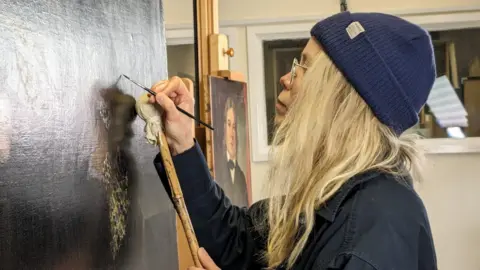
"There's often decades or hundreds of years of discoloured, dark brown varnishes so the colours are disguised," Eeva Kukkonen says.
"It's always really satisfying to bring something back to how the artist intended it."
Critchlow & Kukkonen Ltd is a painting conservation and restoration business, working on art from as far back as the 16th Century.
Run by Eeva Kukkonen and Lucy Critchlow, it has previously restored artwork for Hull Maritime Museum, Sheffield Museums Trust and National Trust properties including Beningbrough Hall in York and Nostell Priory in Wakefield.
 Critchlow & Kukkonen Ltd
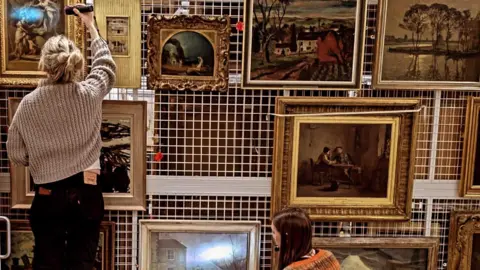
Each restoration is a painstaking labour of patience and precision that can take either days or months to complete, with a recent project spanning over 700 hours.
Using synthetic materials like varnishes, artwork is typically stripped of older restoration techniques and restored using newer, reversible methods.
"People used to use materials to restore paintings that weren't quite up to scratch, such as oil paint. Hopefully what we do now isn't going to degrade as badly," Eeva says.
Every painting responds differently to the solvents used in the restoration process which "keeps you on your toes", she explains.
Whether it's tempting or not to add extra shading or detail to a scene is beside the point of a restorers' work - they're "dealing with damage" only.
This wasn't always the case however; according to her, an understanding of restoring artwork has vastly evolved over the years.
 Critchlow & Kukkonen
"The ethics of conservation is quite an important issue these days. You shouldn't be tampering with the original piece of art," she says.
"[In the past] there wasn't really a conservation training as such, though people who would have been fixing paintings would have been painters and artists.
"They might have had a more liberal touch, so if there was fairly small damage in the sky, instead of just retouching, sometimes people just repainted the entire sky."
Landscapes and historical scenes are a favourite to work on, Eeva says, especially when they depict a local area and show how it has changed, centuries later.
"Because we're in Yorkshire, there's quite a lot of artists that become familiar, because they're in a lot of collections.
"There's a lot of local artists, as well as bigger national names that come up."
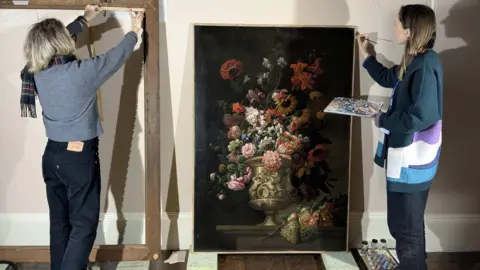
Paintings can vary in size too - one by 17th Century artist Sir Thomas Lawrence and a portrait of King James II at Castle Howard are larger pieces the studio has tackled.
"We also get a lot of portraits, especially of old men," Eeva jokes.
"So when you get a portrait of a woman it's quite exciting to give some airtime to women in history."
 Critchlow & Kukkonen Ltd
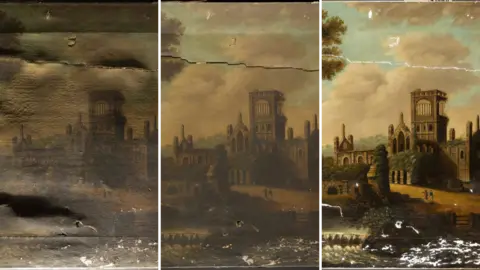
One of Critchlow & Kukkonen Ltd's most recent projects was restoring a painting of Kirkstall Abbey, for Leeds Museums and Galleries.
The artwork, by an unknown artist, was donated in 1958 and has spent at least the last 25 years in storage due to its condition, according to curator Kitty Ross.
"The [damaged] paintings have to be more or less hidden even from people looking at them. If they're in store, then they're not of any great use," she says.
A grant from Friends of the Leeds City Museums enabled the painting to finally be restored, which Kitty described as "pretty exciting".
It's actually not the only Kirkstall Abbey painting that Eeva has worked on for the museum - although the first was in such poor condition, the reveal came as a surprise.
"For years, we didn't know what it was - is it a dog? It was a complete gamble," Kitty adds.
"That was even more exciting."
'We're perfectionists'
When visiting stately homes or museums in the area, Eeva often spots the studio's handiwork on display, which gives her a different perspective on the artwork.
"It's really nice to see, because we look at them out of the frame [and] we're all perfectionists, we could keep working on them for ages.
"When you see it in its place in a house or a museum, back in its frame and on the wall with other pictures, they just look different there. It's a nice feeling."
However, sometimes it can be a bit of a "busman's holiday", she admits, as it's "hard not to look at the problems in paintings".
"You just start to peer at them at an angle to see if there's any flaking paint," she adds.
"It's quite hard to stop, so I often enjoy going to contemporary art museums because I don't have that problem looking at sculptures or something like that."
Listen to highlights from South Yorkshire on BBC Sounds, catch up with the latest episode of Look North.
