What is a Fata Morgana? Sea mirage sparks queries

 St Ives Boats/Dolly P
An image showing a rare mirage off the coast of Cornwall has led to speculation on social media about exactly what it is.
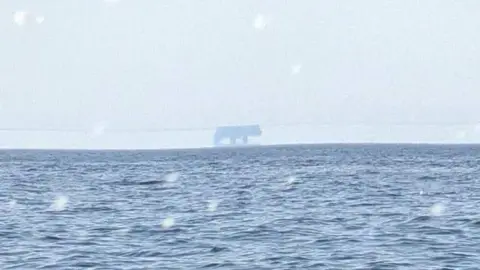
Mike Hancock, from boat trip operator St Ives Boats, recently spotted it off the north coast and said the "surreal" experience looked like a "huge bear on the horizon".
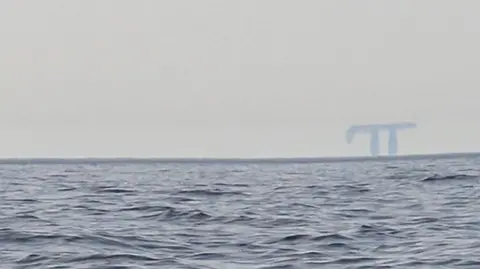
Online, people speculated that it might be a ship, a crane or other objects, but it was actually a Fata Morgana mirage of an aircraft carrier.
A Fata Morgana is a highly complex, fast-changing form of a superior mirage that drastically distorts distant objects, stacked vertically into unrecognisable shapes or towering structures.
The name comes from the Italian phrase for "Fairy Morgana", referencing King Arthur's shapeshifting half-sister, Morgan le Fay, due to the mythical way these illusions seem to build castles in the sky.
Hancock said he spotted the aircraft carrier in the distance while sailing near Portreath on Cornwall's north coast.
"It's something that's quite cool to see but not unusual, so we didn't pay it too much attention," he said.
He then started to head west towards Pendeen and spotted what he thought was another large ship on the horizon.
"It was way out of our navigation range so weren't worried about it," he said.
"As we carried on west it did start to get a little bit odd because it started to change shape."
"Initially it was like two huge blocks and they suddenly got taller, then they became very fuzzy, then became thin and defined and the shape changed and changed," he said.
"At one point almost looking like a huge bear on the horizon.
"Then it changed in to the mathematical shape of Pi, a really defined shape.
"We realised we were actually looking at a mirage and it was a mirage of the aircraft carrier inverted, which was now many miles away from us."
 St Ives Boats/Dolly P
Hancock said he had seen mirages before and Fata Morgana was a common effect in some areas of the world but it was something he had never seen off Cornwall.
"It would come in and out of focus and we actually had three horizons at one point, the whole horizon sort of tripled and was bendy," he said.
"It was just so surreal."
How does a Fata Morgana form?
Intense inversion: It requires an exceptionally strong and steep temperature inversion, where a thick layer of freezing air is trapped under a layer of much warmer air.
Atmospheric ducting: This extreme temperature contrast creates an atmospheric "duct". The duct acts like a curved lens that bends light rays far more dramatically than a standard superior mirage.
Thermal ripples: The air layers are rarely perfectly flat. As they ripple and move, the refracted light continuously changes, causing the mirage to shift rapidly before your eyes.
What does it look like?
Vertical stretching: Objects like small boats, low cliffs, or small islands are stretched upwards into massive, surreal columns or walls.
Inversion and magnification: The illusion frequently displays multiple images of the same object stacked on top of one another — some perfectly upright, others completely upside down.
Rapid compression: A tall ship might look like an enormous castle one second, then compress into a flat, compressed line the next.
Famous historical impact: The Flying Dutchman - these mirages are the likely source of the famous ghost ship legend, as sailors saw distorted, giant ships seemingly floating high in the sky or hovering upside down.
Phantom islands: Early Arctic and Antarctic explorers frequently mapped massive mountain ranges that turned out to be Fata Morgana distortions of flat sea ice, leading to entirely fictional islands being added to old maritime charts.
Follow BBC Cornwall on X, Facebook and Instagram. Send your story ideas to spotlight@bbc.co.uk.
