The airfield where motor racing returned after WW2
 Paul Joslin/BBC
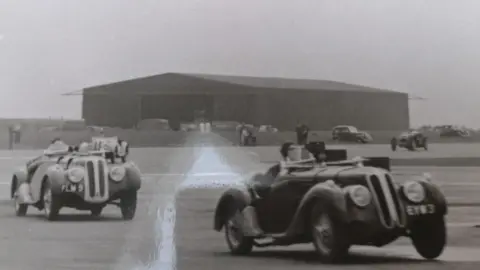
In 1946, the full-throated roar of motor racing returned to Britain, a country starved of such entertainment since 1939.
But the MGs, Bugattis, Aston Martins and a lone Rolls-Royce did not compete at Silverstone in Northamptonshire, which later became the home of motorsport.
Instead, British motor racing was reborn nearly 80 years ago on 15 June at RAF Gransden Lodge, a few miles west of Cambridge.
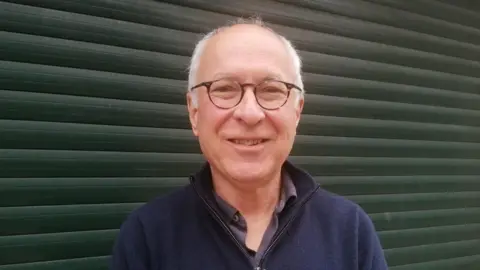
"I think by setting a template, it was showing people just what was wanted," said researcher Roger King.
Motor racing had restarted in Europe shortly after VE Day in the summer of 1945, but Britain lacked tracks.
King, a former member of Cambridge University Automobile Club, said: "Circuit racing had been allowed in Europe for several years, but we had always banned racing on public roads, so we had no circuits."
 Paul Joslin/BBC
Before World War Two, the only racetracks in place were at Donington Park, near Derby, and Brooklands, near Weybridge, Surrey.
"Donington Park was still being used as a massive storage depot by the Army, who wouldn't let go of it," he said.
"And Brooklands had been partially built on with aircraft hangars and would never come back to being a full circuit."
 Paul Joslin/BBC
Many members of Cambridge University's automobile club were engineering students and bursting to get their cars back on a racetrack.
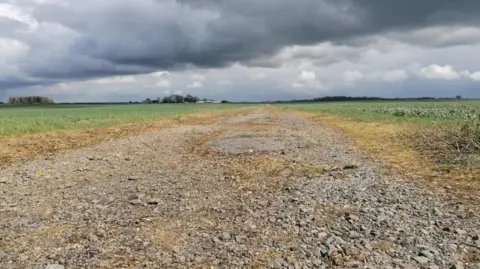
By 1944, there were more than 700 airfields in Britain, and they were an obvious choice for a circuit, said King, who has undertaken extensive research into the Gransden Lodge races.
Airfields that had been home to bombers were ideal because they had both concrete runways and perimeter roads.
Chris Sullivan, Gransden Lodge historian, said the airfield "was originally built as part of several airfields to carry out some fairly secret trials of radar and similar technologies".
Operational flying from Gransden ended in March 1946, meaning it was still in good condition, so the students thought it might be suitable as a racetrack.
In the 1990s, King received a letter from student James Obeyesekere, who competed in 1946 and later became a Sri Lankan barrister and politician.
"He said, the double-dyed racing stalwarts, having been starved of motorsport over the war years, were waiting with their tongues hanging out for something, or anything, to happen," King recalled.
"'This included Earl Howe, who was president of the RAC permit committee, who, on the pretext of testing the suitability of the circuit for granting the permit to race, kept scorching round and round, enjoying himself to such an extent that it was with the greatest of difficulty we were able to stop him."
 Keystone/Getty Images
The club had found its circuit, but it needed to go through eight different committees to get permission to race on an airfield.
So, its president, David Hodkin, had the brainwave to go straight to the commander of No 47 Squadron RAF, Air Commodore David Atcherley.
King said: "He simply declared, 'This sounds a jolly good idea' and signed the permit, without bothering the Air Ministry."
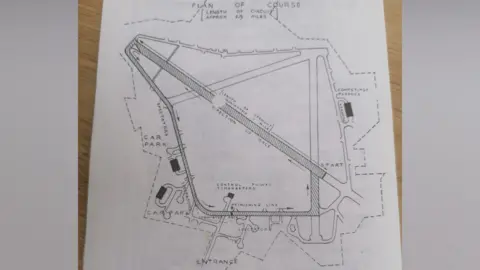
By 15 June, a 2.3-mile (3.7km) anti-clockwise circuit had been laid out, and barbed wire was strung up to keep the spectators back.
A wide range of cars took part in the racing, including Rileys, Fiats, Fraser Nashes and Alfa Romeos.
 Paul Joslin/BBC
King said drivers who would go on to be very influential in the post-war sport were there, including Dennis Jenkinson, the journalist and navigator for Stirling Moss, and Roy Salvadori, who won the Le Mans 24 hours in an Aston Martin in 1959.
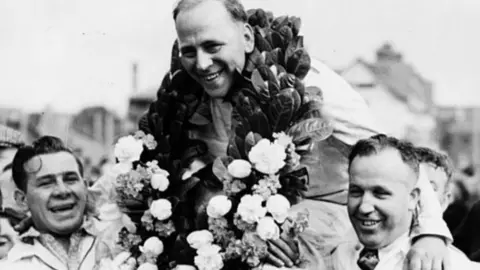
The feature event of the day was the Gransden Lodge Trophy, which was taken by Reg Parnell in his Maserati in a time of four minutes and 50 seconds.
Just over a year later, Gransden Lodge hosted another bigger race, attracting about 15,000 spectators.
But a new policy from the RAC in 1948 effectively banned casual race meetings at airfields, said King.
"[The Air Ministry] had made this deal with Silverstone to permit more meetings there, and I guess as far as Gransden Lodge was concerned, it couldn't compete on that level," he explained.
But he believed what took place at the airfield was a template for how Silverstone would go on to be run.
"Whilst... motorsport would have come back to Britain without Gransden, it certainly wouldn't have in 1946," he added.
Do you have a story suggestion for Cambridgeshire? Contact us below.
Follow Cambridgeshire news on BBC Sounds, Facebook, Instagram and X.
