The problem with losing 'osmosis learning'

 Getty
GettyObserving and chatting to colleagues helps us gain valuable knowledge. How do we make that happen in the post-pandemic workplace?
Business development specialist Sarah Lomax started as director of commercial services at a London-based charity a year ago. Yet until a few weeks ago, she hadn’t set foot in the office or met any of her colleagues, including the 12 she manages, in person.
Lomax was new not only to the job but also to the charity sector, having previously worked in media. She knew from the start she had a lot to learn, and is full of praise for the support she’s had from her organisation. Yet she admits that not being around her colleagues for those vital first months has been more challenging. “A year on, I still don’t feel confident in the amount of knowledge I’ve picked up. I still feel like I’m really lacking in that sector knowledge,” she says.
Of course, settling into a new job is always stressful. Carefully working out who does what, how things work and how you’re expected to behave all takes time. But for people who started new roles remotely during the pandemic, that process has been particularly challenging. That’s because working in proximity to your colleagues not only provides important social interaction but also enables you to soak up crucial work-related knowledge, a process often called ‘learning by osmosis’. A recent survey by Slack’s research consortium Future Forum showed that 42% of workers felt working from home gave them fewer chances to learn from colleagues.
As companies start to experiment with hybrid working models, some business leaders are concerned that workers could miss out on this critical aspect of their development, potentially affecting their performance. But experts say that rather than workers losing out, the rapid change in work culture and the speed with which collaborative technology is being developed could usher in learning experiences that are more efficient and could even give more people a chance of succeeding.
The power of observation
Psychologist Albert Bandura pioneered the idea of social learning in the 1960s. From his studies of children’s learning pattern, he argued that “most human behaviour is learned observationally”. Bandura’s Social Learning Theory has started making its way into the workplace in recent years, as employers recognise how important it is to enable workers to learn from each other, on an ongoing, informal basis.
Popular learning models have tended to suggest that 20% of our learning about a job comes from observing others, although newer research suggests that figure could be even higher. LinkedIn’s 2020 Workplace Learning Report also showed that teams that feel they are learning new skills together are more successful in general.
Of course, everyone needs formalised training when they join a team, on things like software or legal processes. But there are also the less obvious things to learn, like how do you fix that error message that pops up all the time? Who is the most helpful person in the IT team? Is it OK to wander over to the marketing team for a chat? Why do we work with this company but not that one?
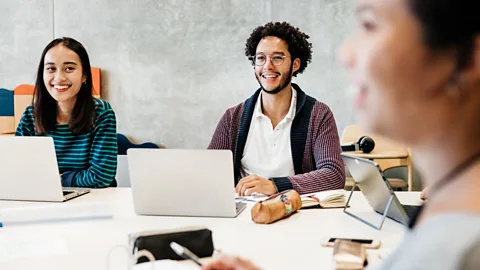
“The truth is once you’re in a physical place, osmosis tends to happen because you’re sitting near someone,” says Lynda Gratton, a professor of management practice at London Business School who has researched how companies are responding to enforced remote working.
 Getty
GettyBut Gratton points out that in reality, most workplaces weren’t particularly conducive to this kind of learning before the pandemic. “Research shows that as offices moved from cubicles to open spaces, what happened is that people didn’t wander around talking to each other because they [the offices] were noisy.” Many people, she says, responded by putting on headphones and interacting primarily with their computers.
Then when Covid-19 forced people out of offices into home-working, there was “legitimate concern” about how this shift would further affect learning. While her research suggests people working remotely actually talked to their direct teams more than they did in the office, they spent far less time interacting with other teams, meaning fewer opportunities for wider knowledge sharing. And, as Lomax notes, remote working makes it harder to reach out informally to colleagues; it feels more awkward asking a basic question when it has to be a Zoom or an email, rather than a chat.
Why intentionality matters
Given that learning by osmosis is so important, but hampered by both modern offices and remote working, organisations may need to work harder to ensure their employees do continue to learn from each other. For Gratton, one solution is to leave less learning to chance “You can’t just expect everyone to be in the office and somehow osmosis happens,” she says. “You've got to intentionally design space differently, you’ve got to intentionally design proximity differently and thirdly you’ve got to intentionally design encounters.”
In the office, this includes putting serious thought into who sits where, which is “one of the drivers of osmosis”. Gratton cites the example of UK-based design company Arup, which would regularly move teams around the building to increase learning opportunities. But it also means ensuring that people have the encounters critical to meaningful learning rather than leaving them to chance. “Part of designing work might be to say to people, ‘When you're going to a board meeting, make sure you take a junior person along’. These are incredibly important ways of learning.”
Brian Elliott, vice-president of Slack and executive leader of Future Forum, agrees that intentionality is critical, particularly during onboarding. The idea that “just because you’ve landed somebody in a pod of humans, they would learn from that and they would figure out how to make work happen” always relied on “a little bit of random chance”, he says.
It was also not fair. “More often than not, it benefited the people who looked more like, and were more like, the majority of people around them.” It’s fairly easy for, say, a white male dropped into a team of 70% white males “to find someone that you can pair up with, that you can ask questions of, that you can learn from”, he says. “If you are the only black woman that has landed in that situation, you’ll have a much harder time.”
Rather than relying on chance encounters, he says, “if you put more thought into how you want that to happen it can actually work better”. That might be thinking more carefully about whether a new person is surrounded by people with experience they will need to absorb, as well as ensuring there is a team-member with the interpersonal skills to respond to their questions. It also means creating very clear onboarding plans, including setting out who a new recruit is expected to talk to in their vital first few weeks.
Osmosis learning in the post-pandemic workplace
As we emerge from the pandemic and begin to adjust to how workplaces have changed, whether by embracing different forms of hybrid or allowing far more staff to work remotely, we will of course depend more on technology to interact with our colleagues.
 Getty
GettyBoth Elliott and Gratton agree that recent technological developments have revolutionised how well we can work and also socialise with our colleagues. Gratton, for example, has written about how PwC set up “virtual worlds" for their new recruits being onboarded remotely, so people "still had a chance to bump into each other” and form important bonds. Innovations like this could “completely change the way we think about work”, she says.
But she also believes organisations shifting to new working models will need to learn how to make the most of periodic face-to-face encounters and “really dial up the office as a place of co-operation”. For example, one concern about hybrid is that senior managers with good home-working environments might choose these over the office. Gratton says employers are beginning to address this potential issue by ensuring that workers’ in-office days overlap. “People are now saying, ‘OK on Wednesday, that will be a day where we do osmosis learning’. They’re being more intentional about it.”
Victoria Usher, CEO and founder of PR company Ginger May, has also come up with a way to help new recruits find their feet by assigning everyone a slightly more experienced ‘buddy’. Employees are encouraged to fully invest in this relationship, so junior partners "who don't know what they don't know" can feel free to ask basic questions without fear of looking foolish. Usher says it has also helped everyone that the company has “more systems than ever before”. Writing things down that were previously passed on by word of mouth or observation leaves less room for uncertainty, she notes.
Gratton fully agrees that “making tacit knowledge explicit by manuals and checklists” is more effective than relying on osmosis learning, and says many companies that have embraced remote working are adopting this approach. “What is it young people learn through osmosis? One is they learn how to dress,” she says. “Well, you can write that down in a manual. Or they learn how to address a client – you can write that down.”
Elliott says Slack has introduced written team-level agreements which lay out expected behaviours, as a group and with each other. This is all part of being “much more transparent in the sharing of information and knowledge”, rather than waiting for everyone to pick up information as they go. If there are clear processes for sharing information, everyone has the option to read that information and learn from it in their own time.
All of this means putting an end to what Elliott calls the “happenstance” of learning in the workplace and instead building a system that really thinks about what knowledge each worker needs for the job they’re doing, who they need to spend time with to gain it, and how that knowledge can be shared even more widely, so everyone benefits – wherever they are working. Ultimately, says Gratton, an office “isn’t really a physical location, it’s a place of connectivity”. So, the key to learning, whether in person or remote, is to make the most of those connections.
Bandura argued that without the chance to observe others, learning is an “exceedingly laborious, not to mention hazardous” process. The pandemic has certainly made that clear to many of us. But the hybrid era has also presented organisations with an opportunity to rethink how informal social learning happens among their people. This might require a little more investment from managers upfront, says Elliott, but “honestly that type of investment should be happening whether team is all together or distributed in the first place”.
