'A primary school pupil broke my cheekbone'

 PA Media
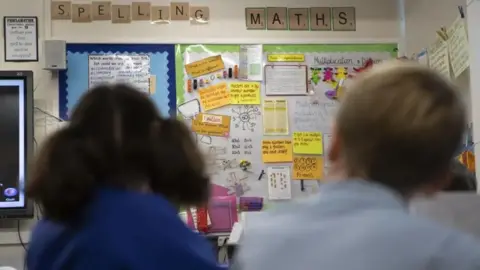
Raha is scared to go back to work as a primary school teaching assistant after her cheekbone and wrist were broken when she was flung to the floor by a pupil.
The incident is one of tens of thousands of attacks on school staff each year and many now say violence in the classroom is out of control.
Figures obtained by BBC Scotland News through Freedom of Information (FOI) requests show there were more than 35,000 physical assaults - a 55% increase over two years.
More than two-thirds of Scotland's councils supplied figures in response to the FOI request but other councils were unable to contribute due to way their data was stored.
Unions say poor reporting systems around the country mean this isn't the full picture and the true figure of assaults on staff will be higher.
Cosla, the group that represents local authorities, said it had no reason to believe there was under-reporting while the Scottish government said its action plan was developing guidance to help improve the monitoring of violent incidents.
Raha, whose name we have changed to protect her identity, says she was left "traumatised" by her experience of violence in a mainstream primary school.
She suffered fractures to her face and wrist, and other injuries to her ankle, knee and the right side of her body when she was pulled on to the floor by a pupil.
"For up to two, three months, I wasn't able to speak and I couldn't eat properly," Raha told BBC news.
"[My managers] say this is part of the job, so we can't do anything."
She says that in her experience the incidents had escalated in the past five years, coinciding with a increase in children with more complex additional support needs in mainstream schools.
Raha claims she has had no specific training in how to manage children with additional needs, and that if risk assessments are carried out, they are not passed on to support staff.
"They have very challenging behaviour," she said.
"They don't talk, they kick the staff, they punch them and also they spit at us. It is very severe."
The official definition of violence in the workplace includes verbal abuse, threats or harassment.
This means that incidents of 'violence' recorded in Scotland's schools could include anything from swearing at a teacher right up to a very serious assault.
The BBC wanted to know the numbers of physical assaults on school staff and asked all Scotland's 32 councils for that specific figure.
Data recorded in health and safety systems by academic year was provided by 25 out of Scotland's 32 local authorities.
Five councils were unable to provide the equivalent figures because they do not store the figures in academic year format.
One - Aberdeen - could not provide the data as they don't record physical assaults separately from physical injuries.
And Stirling Council said its health and safety system did not differentiate between assaults on pupils and assaults on teachers until it made a change earlier this year.
Of the ones that did provide data, Glasgow City Council – Scotland's largest local authority – recorded the highest number of physical assaults at 4,960, a jump of 87% on the figure two years before.
It told the BBC it did not tolerate violence or aggression of any kind and said appropriate sanctions will always be taken.
Glasgow said it was working with unions on new procedures to protect teaching staff.
Edinburgh was the second highest, with 3,525 physical assaults on staff, up 70% in two years.
It said it had a zero-tolerance approach to abuse against teachers and support staff and any reports were taken extremely seriously.
Fife Council recorded the third highest number at 3,524, up 50%.
The council said its reporting process has been simplified and streamlined to address under-reporting from staff and trade unions.
 Getty Images
Teaching assistant Stephanie told the BBC she was off work for months after a primary school pupil punched her in the face.
"It did knock my confidence," she said.
"It stopped me going out with my family and friends.
"I had to go on antidepressants from my doctors."
Stephanie said she was offered a chance to transfer to another school because she was afraid to return but she didn't think she should be the one to move.
She said one of the biggest problems was the lack of consequences - even when pupils had been violent.
"When I go in each day I think, oh my goodness what's going to happen now?" she said.
"There's not a day that goes by that there is not an incident.
"We get the police out to our school most days."
 PA Media
Raha and Stephanie both work in mainstream primary schools but staff in special schools often face even worse conditions.
Andrea says the violence at the school she works in has increased dramatically in the past decade.
Her nose has been broken twice and she's experienced a bleed on the brain, torn ligaments in the back of her leg and many bites, all at the hands of pupils in the last few years.
She said in the past being assaulted was occasional but now it is normalised and that the children are "more aggressive, more violent".
"You're getting hurt, it's becoming the norm," she said.
Andrea says special needs teachers are now using PPE such as bite-proof gloves, shin guards and face shields which they would only need occasionally in the past.
"You would never wear it constantly," she said
"Now you're wearing this for the minute you walk in the door to the minute we leave the classroom at 3 o'clock."
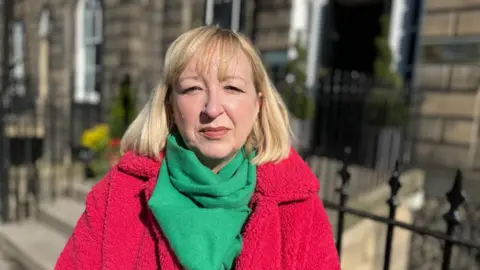
Sylvia Haughney, from the Unison union, says she is hearing the same stories from teaching assistants across the country and that local authorities need to do far more to train, support and risk assess.
A Unison survey last year of 450 staff suggested 89% had been punched, 93% had been kicked and 82% had been bitten.
She said cuts in resources and reductions in specialists, including educational psychologists and speech and language staff, had exacerbated the problem.
"On a daily basis, our members face being swore at, misogynist language being used, racist language being used, punched, bitten, spat on, objects thrown," she said.
"I'm saying objects, but this is possibly more tables and chairs. It's not just a pencil that's been thrown now.
"So the lessons are disrupted on a daily basis. Ten years ago this wasn't happening."
She says staff are regularly told they just need to put up with it which would not happen in any other job.
The Scottish Government Action Plan on behaviour was published in 2024 but staff say it has made little difference.
They say there are often no consequences for pupils who have been violent, and there are insufficient resources to try to improve the situation.
Teachers and unions say schools and local authorities are reluctant to exclude pupils no matter what they have done.
The number of exclusions in Scotland has fallen by 75% in 20 years.
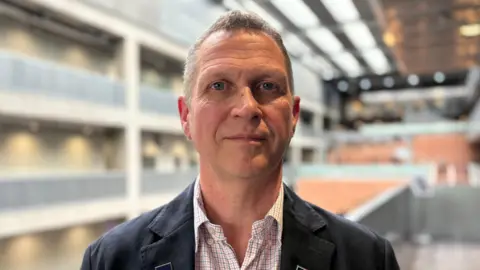
Mike Corbett, president of the NASUWT teaching union, said the true figures for attacks on teaching staff will be higher than those uncovered by the BBC because some schools dissuade staff from reporting assaults and others don't give them time to do so.
He said: "We would be almost 100% sure that this is not the full picture. How can you properly address things unless you have the full picture?
"You need to be looking at improving the recording systems to get that true picture.
"We need to be looking at what needs done to make teachers safe in the workplace."
Andrea Bradley, of the EIS union, said teachers had seen a significant increase in violence and that much of this was down to the diverse range of needs of children not being met.
Bradley said there was no one solution but that there was a need for "increased investment in schools, in school staff, in reducing class sizes, and in tailored support for young people with additional needs".
A spokesperson for the council group Cosla said no teacher should be subject to abuse and they would support any staff who experienced it.
"We have no reason to believe that there is underreporting not least because recording of accidents and injuries at work is a legal requirement under health and safety legislation," they said.
A Scottish government spokesperson said it had been working with Cosla and the teaching unions to implement Schools Action Plan.
"Last year as part of this action plan we published new guidance for schools on consequences, developed in collaboration with headteachers, teaching unions and local authorities.
"The second annual progress report on delivery of the action plan shows that good progress is being made to deliver all 20 actions within the plan.
"As part of the plan, a working group is developing guidance to support improvements in the recording and monitoring of violent incidents across local authorities and schools."
