How plastic birds lured puffins back to an island

 Keirron Tastagh, Adventurous Experiences
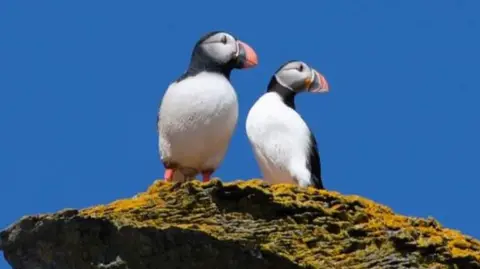
Ten years after conservationists started a project to bring back puffins to a tiny island in the Irish Sea, there have been several signs that suggest it is working.
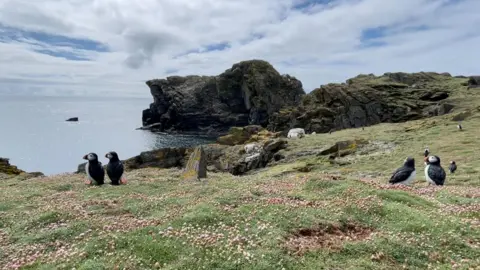
However, the three colonies of puffins which can now be seen on the Calf of Man, a small uninhabited island and nature reserve off the southern tip of the Isle of Man, are not quite what they seem.
The birds are, for the most part, plastic.
The scattered groupings of decoys have been placed on the islet to fool passing real puffins into believing they already live there, and so entice them to join them.
The idea is simple, but it is one which the Manx Wildlife Trust, which has led the project, said had seen positive signs, with regular reports of puffins in the areas of the colonies and sightings of them gathering nesting materials.
Why are puffins wanted?
Puffins can currently be found in coastal colonies across the British Isles, from the Scottish Highlands and Northumberland in northern England to the south-west tip of Wales and the Isles of Scilly, and the Calf of Man, which sits between those two extremes in the middle of the Irish Sea, once had a native population.
However, populations declined and disappeared in the 1980s after a shipwreck brought rats - or long-tails, as they became known locally - to the island.
That led to the decimation of several ground-nesting bird species, including the Manx shearwater, as the long-tails would eat the eggs.
However, the Manx Wildlife Trust (MWT) and landowners Manx National Heritage took part in an eradication programme in 2012 and 2013, which saw the numbers of species like the eider duck and Manx shearwater rebound.
Their hope is that puffins will be next.
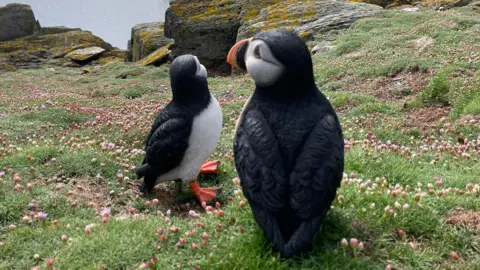
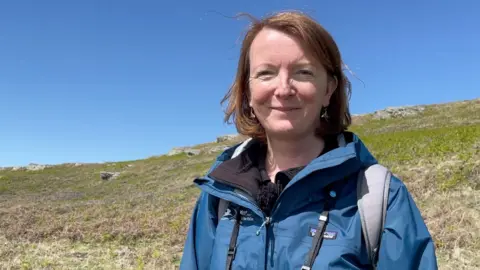
MWT's marine conservation officer Lara Howe said the success of the programme presented "a great opportunity to start encouraging the puffins back to the Calf", and there are now three decoy colonies, built up over the past 10 years.
She said the latest grouping was created last year as "a result of us actually seeing puffins in this area on fairly regular basis, so we decided to expand".
How does it work?
Howe said puffins were highly social and prefered to nest in busy colonies, making natural recolonisation slow.
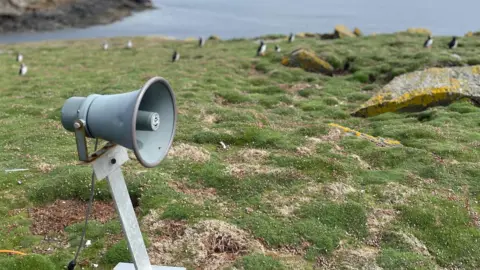
While the decoys act as a physical draw for passing puffins, she said for those birds flying at some distance away, there was a second layer of enticement.
A speaker system has been set-up among the colonies, which plays the sounds of puffin calls to catch the birds' attention.
"If they're flying past and don't see anything, they might miss it, but they'll hear the calls, come closer, see the decoys and think, 'this is a great place'," Howe said.
"We are seeing increased numbers of puffins on the water and around the Calf which is really positive."
Are puffins back for good?
The MWT said there were signs the approach was working.
Numbers of puffins seen on the water around the island have increased in recent years and sightings on land are becoming more common.
Howe said one breakthrough moment came in 2021, when a real puffin was photographed sitting beside a decoy.
"It gave us real confidence that we were on the right track," she said.
The bird was later seen collecting nesting material, though no chicks were ultimately recorded.
Last year brought further encouragement when a puffin briefly landed near researchers observing other seabirds.
For conservationists, even those fleeting visits were significant.
Any pufflings yet?
Yes, baby puffins are quite adorably called pufflings.
Howe hoped the first successful breeding attempt was imminent following reports of puffins gathering nesting material.
She said puffins and other seabirds were declining across the British Isles due to pressures including overfishing, particularly of sand eels, and habitat disturbance.
But that made the Calf of Man, largely undisturbed and free from predators, an ideal refuge, she added.
"It's effectively a nature reserve," Howe said, adding that other success stories there gave them reason to be optimistic.
She said Manx shearwater numbers had risen to more than 1,000 pairs following the rat eradication programme.
She added that there were not many positive conservation stories at the moment, but this showed what can be achieved "through collaboration with other organisations and people who really care about the environment".
Read more stories from the Isle of Man on the BBC, watch BBC North West Tonight on BBC iPlayer and follow BBC Isle of Man on Facebook and X.
