Trial success for woman who fainted while eating

 British Heart Foundation
A woman whose heart stopped beating properly when she ate can now enjoy food after having what has been described as a cutting-edge medical procedure.
Sarah Hall, 50, a midwife from St Albans, said her husband would have to sit next to her during meals in case she lost consciousness.
She was terrified to have dinner with friends in case she collapsed.
But after undergoing a procedure known as a cardioneural ablation (CNA), which generated heat to a specific part of her heart to safely destroy problematic nerve cells, she said her life was "truly back to normal again".
Sarah had cardioinhibitory swallow syncope, a condition which has been reported fewer than 150 times worldwide, according to the British Heart Foundation (BHF).
It is a type of vasovagal syncope – the medical term for fainting caused by a sudden drop in heart rate and blood pressure.
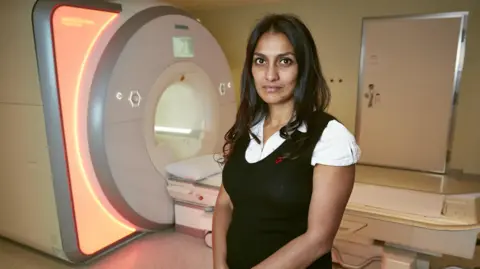
The BHF said she received the CNA treatment as part of a trial at Hammersmith Hospital in London to help people with the condition who had not responded to medication to prevent them fainting.
It is hoped Sarah's experience can pave the way for larger trials and wider adoption of CNA.
"While there are risks associated with any medical procedure, these findings are encouraging," said Dr Sonya Babu-Narayan, BHF's clinical director and a consultant cardiologist.
 British Heart Foundation
Sarah was referred by her doctors to the trial because of concerns about giving her a pacemaker at a younger age.
"In the months leading up to my ablation, every time I ate I would feel the blood draining from my head and be overwhelmed by dizziness which turned everything black until sometimes I lost consciousness," she said.
"I never knew when it would happen, and eating had become functional, unenjoyable and something I avoided socially.
"Those around me treated me every mealtime as a 'high alert' situation.
"At its worst, this was causing me to lose consciousness multiple times a day."
'Living without fear'
The BHF said all the people in the trial had slowed heart rates during their fainting episodes, and they reported 19 blackouts a year on average.
But a year after the treatment, the average number of blackouts fell to about one a year.
About 75% of the group who underwent the CNA procedure no longer fainted at all.
Dr Mohamed Zuhair, a researcher at Imperial College London, which led the trial, said: "CNA offers a way to treat the root cause of this condition. It allowed people to get back to normal lives without needing a pacemaker.
"We hope that this procedure will be adopted by more clinicians."
Sarah's condition had also prevented her from driving and she was off work for several months.
"It was one of the hardest times of my life," she said.
"But now I can live without fear."
Do you have a story suggestion for Beds, Herts or Bucks? Contact us below.
Follow Beds, Herts and Bucks news on BBC Sounds, Facebook, Instagram and X.
