New station bollard is 'disorientating safety risk' say campaigners

 BBC/Seb Cheer
Any visitor to York in recent years will be familiar with the sights and sounds of construction work outside the city's Victorian-era railway station building.
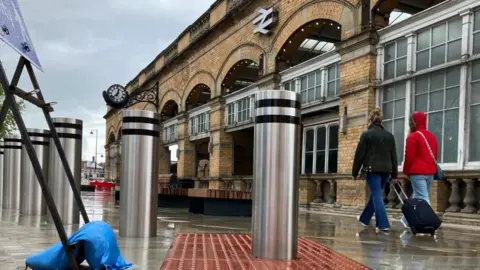
But one of the most recent additions - a series of Hostile Vehicle Mitigation (HVM) bollards - has caused controversy amid the works aiming to improve safety and access for pedestrians and cyclists.
Specifically, one particular bollard, which has been installed on a section of tactile paving - used to aid access for people with sight loss - is proving divisive.
"It's out of the norm, it creates confusion, it could be disorientating and for me, it's a genuine safety risk," explained Scott Jobson, chief executive of the charity MySight York.
However, the Royal National Institute of Blind People (RNIB) said the issue was "not uncommon" across the country.
City of York Council was contacted for a comment.
 BBC/Seb Cheer
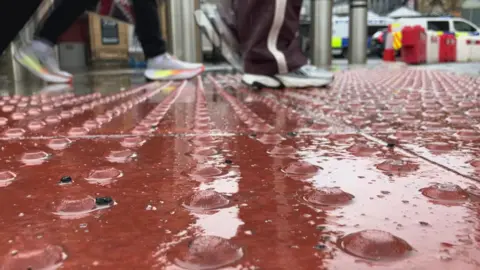
Tactile paving consists of raised patterns such as studs on walkways, indicating safe routes for blind or partially sighted people.
There are several types, but they are most commonly found at pedestrian crossings, the RNIB said.
They also warn of potential hazards ahead, and can be felt underfoot or with a white cane.
Jobson said the placement could not only cause problems for the 7,000 blind and partially-sighted people who live in York, but visitors too.
"People that come and visit York thinking, 'there's some tactile paving - I should be OK'."
Many people would make use of the tactile paving and be surprised by the bollard, he added.
"You don't need to look at inclusive design principles. Sometimes it's just common sense."
Erik Matthies, Policy Lead for Strategy and Public Affairs at RNIB, said physical obstructions like bollards were "one of the biggest challenges that blind and partially sighted people have told us that they face".
"The psychological injury of encountering poorly laid or ineffective tactile paving, combined with the higher risk of physical injury from colliding with the bollards, can leave blind and partially sighted people more wary or less motivated to walk around in future."
 BBC/Seb Cheer
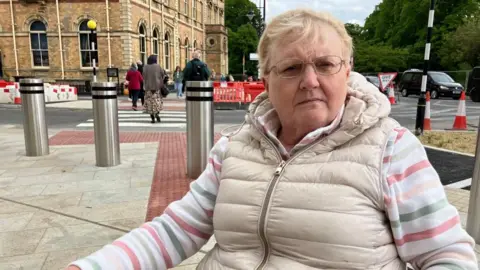
Disability activist Flick Williams, who has a visual impairment and uses a wheelchair, recognised that HVM bollards were "important in keeping people safe".
But, she said, positioning one in the middle of tactile paving was "appalling".
"Blind and visually impaired people need tactile paving to navigate and if you're crossing from the other side, you basically will just walk straight into that."
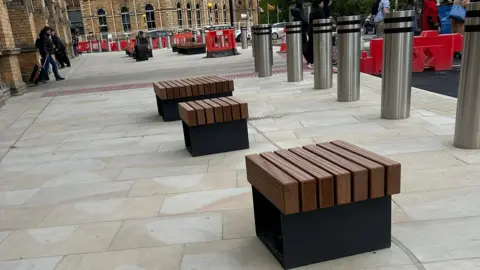
Straight after the crossing, Williams said, people with sight loss could collide with new benches, because they were positioned in line with the tactile paving.
The entire station gateway development "effectively created a really hostile environment for blind and visually-impaired people," she said.
 Flick Williams
Jobson said that if the benches had been discussed with his charity, they would have examined the potential for them to cause a trip hazard.
"Are they the right colour contrast, are they following inclusive standards?"
He added: "When a blind or partially sighted person - for example, with a long cane - has been given the green light to walk, then all of a sudden they walk straight into what looks like a concrete cube, it's going to be a bit of an issue."
Matthies said that while data on the prevalence of the issue nationally was not held by RNIB, "anecdotally it's not uncommon".
"The importance and proper use of tactile paving isn't widely understood by sighted people, which can lead to designers and managers of projects that add on to an existing streetscape, not designing for the needs of people who depend on tactile paving to be laid in areas that remain free of obstacles."
Listen to highlights from North Yorkshire on BBC Sounds, catch up with the latest episode of Look North.
