'We're trying to save Jersey's language and identity'

 BBC
BBCA documentary exploring Jersey's native language and the efforts to protect it will be premiered at a film festival.
À Bétôt? Goodbye? follows the voices of the last native speakers of Jèrriais and the growing movement to revitalise the language.
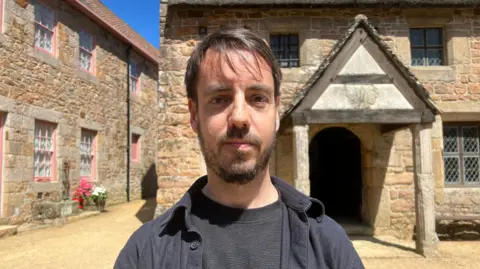
Ben Spink, head of the Jèrriais Teaching Service and the film's producer, said the number of native speakers was reducing. "They're coming towards the end of their lives, which is a really sad moment for Jersey. We felt it was really important to capture their voices and their stories."
Spink said it was a "dream come true" the film would have its premiere at the 13th Parish Film Festival on Saturday, May 23.
The feature length documentary captures the stories and voices of people who still speak Jèrriais.
Spink said the stories in the film would always stay with him: "They told us about how they were beaten in school for speaking the language.
"They told us about how they were discouraged from ever using it, from teaching it to their children," he said.
He added the film explored how the language is still part of island life.
"A lot of our folklore is written only in Jèrriais," he explained.
"So if there's nobody who understands the language, nobody who speaks it, we lose the sense of what those things mean and we lose part of our island's story."
He described Jèrriais as "fundamental" to Jersey's identity.
"Without Jèrriais, Jersey would be indistinguishable from another part of Britain. We do have our beautiful landscapes and unique population, but in many ways it would be harder to recognise Jersey as different without the language".
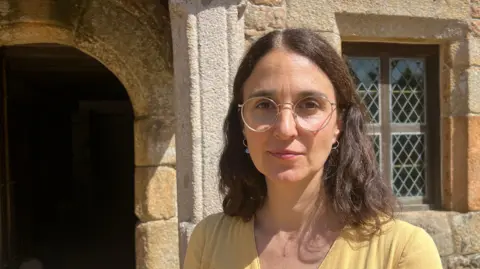
The film was co-directed by local film makers Annigna and Tom Kennedy who run the production company Little River Pictures.
Annigna said the interviews would act as an archive for future generations: "People will be able to revisit those interviews and hear exactly how Jèrriais was spoken by the native speakers."
Since moving to Jersey from Switzerland, Annigna has been learning Jèrriais and said the language was about belonging.
"It really has helped me to reconnect stronger to this place that I now call home and I think that applies to a lot of people who come from another place," she said.
"It's much more than a language, it's about identity. Identity doesn't necessarily mean it's only where you are born, you can also create an identity in a new place where you live and it can become your own."
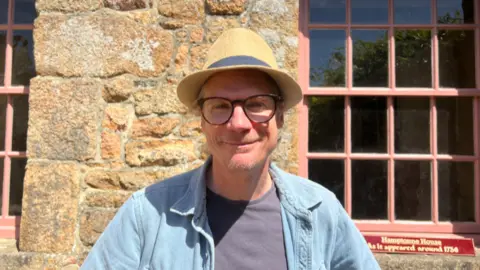
Tom found himself surrounded by people whose first language was Jèrriais when he worked at the Hamptonne Country Life Museum and said "it was a really beautiful thing".
He said he was "very sad" the language was "dying" but was hopeful younger generations could keep it going. He said he heard children learning Jèrriais and speaking together: "That didn't happen in my day," he said.
"They're going to keep that with them their whole lives".
Tom said he was hopeful the documentary would help people realise the language is still spoken: "It's not a dead language. It's alive and speaking," he said.
Follow BBC Jersey on X and Facebook. Send your story ideas to channel.islands@bbc.co.uk.
