UK prepares for food shortages in worst case scenario as Iran war continues

 Getty Images
The UK could face food shortages, including chicken and pork, by the summer if the Iran war continues, in a worst case scenario drawn up by government officials.
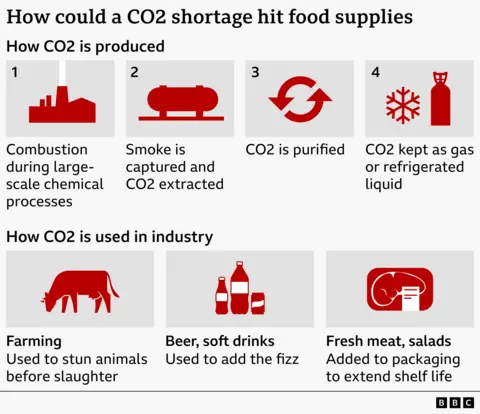
A government source told the BBC it was planning for a scenario which would involve the continued closure of the Strait of Hormuz and breakdowns in the supply of carbon dioxide (CO2), which is used in the slaughter of some animals and in food preservation.
A spokesperson from the Department for Environment, Food & Rural Affairs said it would continue to work closely with businesses to tackle the impact of the war.
"Reasonable worst case scenarios are a planning tool used by experts and are not a prediction of future events", they added.
Since the US and Israel launched wide-ranging strikes on Iran, the Iranian government has responded by effectively shutting the Strait of Hormuz - a crucial waterway for oil and gas transport - causing prices for petrol, diesel and fertiliser to soar.
Speaking after The Timesreported that senior officials had rehearsed scenarios of how British industry would be affected if the Strait of Hormuz remained closed, Business Secretary Peter Kyle said CO2 shortages werenot a concern "at this moment".
"Right now, people should go on as they are," he told Sky News.
Food sector leaders echoed the government reaction, with some saying they were more concerned about price rises than shortages.
Tesco's chief executiveKen Murphy said the supermarket giant's growers, suppliers and manufacturers were yet to raise supply risks.
"We are in very good shape," Murphy said, but he would not comment on what could happen to food prices as"we don't know what it's going to look like, because clearly this is a volatile, unpredictable situation".
The British Retail Consortium, which represents over 200 of some of the largest brands, including Sainsburys and Pret, said it expected the government to carry out contingency planning, adding that retailers were experienced in managing supply chain disruption.
"However, the situation in the Middle East continues to add inflationary pressure at a time when retailers already face significant new costs from domestic policies," a spokesperson said.
Other industry groups, such as the Food and Drink Federation, forecast food inflation to reach 9% by December, while the Agricultural Industries Confederation (AIC) raised concerns about increased fertiliser costs.
Head of the AIC Jo Gilberton said rising fertiliser prices could have an impact on "planting decisions in autumn".
"That's when we end up with a potential food crisis, if the fertiliser and the fuel costs are too much."
Last month, the National Farmers' Union said cucumber and tomato prices could rise over the next six weeks, with the cost of other crops and milk increasing in the next three to six months.
Lord Toby Harris chairs the National Preparedness Commission, an independent body which promotes policies to help the UK be better prepared for threats and challenges.
He told BBC's Radio 4 "the more that we test how we manage under various sorts of scenarios, the better that's going to be" as international events continue to affect the UK.
In response to the war in the Middle East, the government last month temporarily restarted the Ensus bioethanol plant, which produces CO2, renewable fuel and protein animal feed, after it was mothballed in September 2025.
A spokesperson for the plant told the BBC they were "confident we can continue to produce CO2 for the country's needs for the foreseeable future".
The majority of the UK's CO2 is imported from Europe but it is often produced as a by-product when companies make fertiliser, which needs natural gas.
Earlier this week, the International Monetary Fund warned that the war could plunge the global economy into recession, with the UK set to be the hardest hit of the world's advanced economies.
US President Donald Trump has suggested talks aimed at ending the war in Iran could resume this week, after negotiations collapsed at the weekend, prompting the US to blockade Iranian ports.
On Wednesday, Chancellor Rachel Reeves said the US made a "mistake" by ending diplomatic negotiations with Iran and entering into military conflict.
Additional reporting by Rachel Flynn
