'We face selling our home to fund cancer treatment'

 BBC
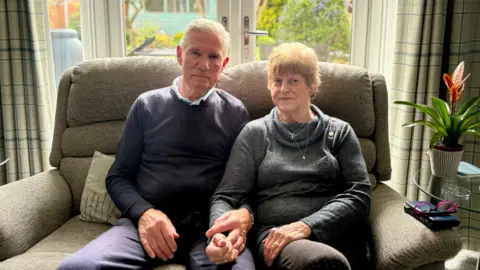
BBCA Dorset couple say they have got no option but to consider selling their home to pay for life-extending cancer treatment they cannot receive on the NHS.
Sandy Harrison, 77, who lives with her husband in Corfe Mullen, Dorset, has bladder cancer that has spread to her spine, liver, and lung, and was told in August she had months to live.
But a new breakthrough treatment was approved for use on the NHS in August. However, she soon found out she was unable to get it on the NHS because she had received two previous treatments.
The treatment, which costs Sandy £9,000 a month, is only recommended by the National Institute for Health and Care Excellence (NICE) for first-line patients only.
When Sandy was told she had months to live, she said she was "aware that I probably wouldn't make Christmas".
But then Padcev, which can double survival rates from the disease and was hailed as "one of the most hopeful advances in decades for people with bladder cancer", was approved for use on the NHS in August.
"We didn't know until we opted for it that we were classed as third-line because I'd had two previous treatments and it was only available to first-line people that had never had a treatment," Sandy said.
This means her and her husband, Patrick, have had no choice but to fund it themselves with their life savings. So far the couple have spent £80,000 on the treatment.
"It's costing me just under £3,000 each treatment, which is three weeks on, one week off," Sandy said.
"It's costing me just over £100,000 a year at that rate to survive."
They submitted an Individual Funding Request (IFR) application but in March were told it had been rejected.
Daughter Kay Cox said they were told her mum's case was "not exceptional".
NHS Dorset said it was unable to comment on individual cases and referred us to NHS England.
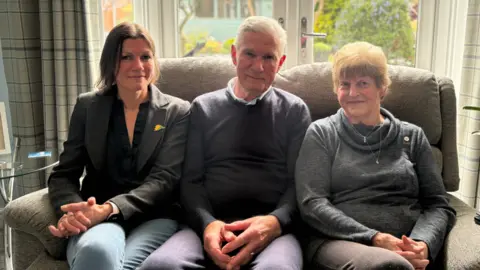
Sandy said when the request was rejected she felt "shock and fear".
Kay said: "It's just not sustainable, but [the drug] is remarkable.
"It is working and that's why even with the cost, they said, well, we've got no option... it's working, we have to carry on taking it."
But to continue, Sandy says they feel they have got no choice but to consider selling their home in Corfe Mullen.
"Nobody knows how long they're going to live, but even if I'm assuming a couple of years, it's over £200,000, and it's a stress you don't need when you're already fighting cancer," she said.
Patrick said: "She's my life. All we got goes to her, but it's just a sad fact that we've got to do that."
When we approached NICE for comment, it told us that Padcev was recommended for the first-line treatment of adult patients, and suggested we contact NHS England about access to the drug for patients.
When we contacted NHS England, it referred us back to NICE.
Sandy's local MP, Vikki Slade, said: "I do understand that there comes a time where a clinical decision is made, that the benefits of a drug don't outweigh either the trauma, or the symptoms, or in some cases, the cost.
"But in this case, there seemed to be clinical evidence that it was working, and therefore, I was really surprised that it would be blocked, not on the basis that it's not working, therefore we can't fund it, which I don't think is an unreasonable position for the NHS to take, but you are third line, therefore, we won't fund it.
"The clinical efficacy in Mrs Harrison's case seems to be showing that this is working - that's the tragedy of it."
