Forever chemicals found across marine life

 PA Media
Current laws are not doing enough to protect the environment or public health against "forever chemicals", a new study has warned.
Research by the University of Portsmouth and the Marine Conservation Society tested for polyfluoroalkyl substances (PFAS) in the Solent, a stretch of water between Portsmouth and the Isle of Wight.
The study found that the chemicals are present throughout the Solent at "multiple levels" of the marine environment.
A Department for Environment, Food and Rural Affairs (DEFRA) spokesperson said the "persistent nature" of the chemicals pose a "long-term challenge for the nation's ecosystems and health" and that it is taking "decisive action" to tackle the sources.
PFAS are a family of nearly 15,000 synthetic chemicals used in everyday products since the 1950s, from non-stick cookware and waterproof clothing to firefighting foam.
Because they are extremely resistant to breaking down, they build up in the environment and in living organisms, earning their nickname 'forever chemicals'.
Two local wastewater treatment plants - Budds Farm in Portsmouth and Peel Common in Fareham, which are owned by Southern Water and together serve around 650,000 people - were found to be releasing a "wide range" of PFAS into the environment in their treated effluents.
A Southern Water spokesperson said: "Tackling the presence of these chemicals is a challenge for society as a whole.
"While we're investing heavily in cutting storm overflows, and are removing more and more contaminants through wastewater treatment, the most sustainable solution is to meet the problem at source by changing legislation to restrict or ban certain chemicals and keep them out of pipes and the environment in the first place."
Professor Alex Ford from the University of Portsmouth's Institute of Marine Sciences, said: "We are seeing chemicals throughout the Solent's food web, from the base right up to marine mammals.
"Current treatment processes are not designed to remove these substances effectively."
 Elise Vermeeren
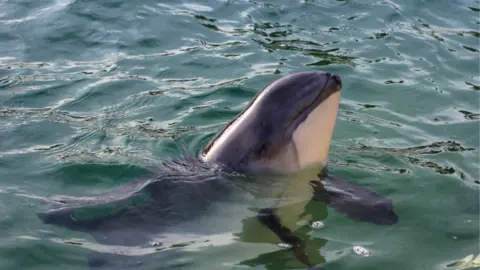
Among the marine wildlife tested, harbour porpoises showed the highest PFAS concentrations, with levels in liver tissue far exceeding the regulatory ecological threshold.
Levels in fish, invertebrates, seaweeds, and other species were lower and, when judged against individual compound limits, mostly within legal boundaries.
Professor Ford added: "Most species fall within the legal limits when you look at individual chemicals in isolation, but when you consider everything together, the picture is more concerning.
"Regulation needs to catch up with the science and treat these chemicals as mixtures, not just individual substances."
A DEFRA spokesperson said: "The first ever PFAS plan shows the decisive action we are taking to better understand and tackle the sources of these chemicals, including in England's estuaries and coastal waters, through better guidance and monitoring, tougher rules on their use and support for transitioning to safer alternatives."
