Hantavirus strain that spreads between humans found in cruise ship passengers
A rare strain of hantavirus, which has been known to spread between people in close contact, has been found in patients linked to a deadly outbreak on a Dutch cruise ship.
The health ministry in South Africa said the Andes strain of the virus was identified in two people who had been evacuated from the ship to the country.
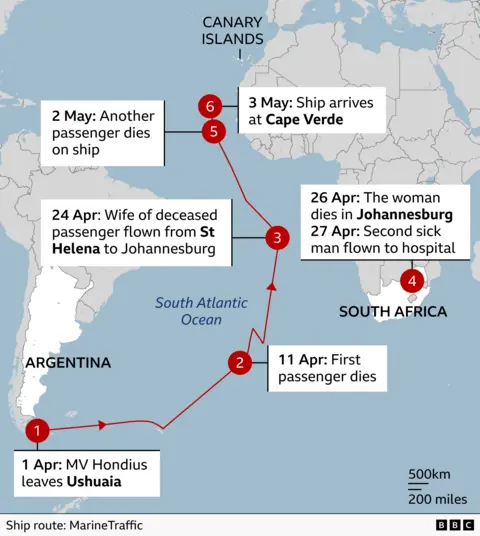
Three passengers on the MV Hondius have died, after it set sail from Argentina on its voyage across the Atlantic Ocean around a month ago.
Another three people with symptoms were evacuated from the ship to receive medical care in the Netherlands on Wednesday morning, the World Health Organization (WHO) announced.
"At this stage, the overall public health risk remains low," the WHO's chief Tedros Adhanom Ghebreyesus said.
"Monitoring and follow-up for passengers on board and for those who have already disembarked has been initiated," he added.
The evacuees were a 56-year-old Briton, a 41-year-old Dutch national and a 65-year-old German, the Netherlands' foreign ministry said.
Earlier, the cruise ship's operator Oceanwide Expeditions said two of the three people due to be evacuated were crew members, including the ship's reportedly British doctor. The third was a passenger linked to a German national who died on board last week.
The WHO has also confirmed a Swiss man who had travelled back to Switzerland after being on board the ship is receiving care for hantavirus at a hospital in Zurich.
Around 150 people remain aboard the MV Hondius under "strict precautionary measures", Oceanwide Expeditions has said.
The vessel is currently anchored near Cape Verde, off Africa's west coast, and intends to travel to the Canary Islands, where passengers could finally be allowed to disembark.
Spanish authorities have agreed to the move, but the Canary Islands' president has announced his opposition to the plan and demanded an urgent meeting with Spain's prime minister.
"I cannot allow [the boat] to enter the Canaries," Fernando Clavijo told Spain's Onda Cero radio. "This decision is not based on any technical criteria and nor have we been given enough information."
In a social media post, he called for "safety and guarantees for the passengers and for the people of the Canary Islands".
Eight cases of hantavirus - three confirmed and five suspected - have so far been identified in people who were on the ship, according to the latest World Health Organization (WHO) update.
The health body has consistently emphasised that risk of transmission to the wider public is low.
The virus typically spreads from rodents via their faeces, saliva and urine. But experts have observed the Andes strain spreading between human patients in previous outbreaks.
South African health authorities have said that the Andes strain - which is prominent in Latin America where the cruise originated - was found in both confirmed patients after tests conducted by the country's National Institute for Communicable Diseases.
A document presented to South Africa's parliament on Wednesday morning, seen by the BBC, says the Andes strain is "the only strain that is known to cause human to human transmission".
It stressed that transmission of the virus is still rare and it only spreads between people in "very close contact".
The document details efforts to trace all known contacts of people known to have been infected, and says that as of this morning 42 of 62 people have been traced.
The contacts include paramedics, ambulance drivers, port officials, flight personnel and health workers. South Africa says efforts to trace all contacts remain underway.
Of the two cases confirmed in the country, one was a Dutch woman who died after her husband had already died at sea. The other is a British 69-year-old who is being treated in a Johannesburg hospital after he was medically evacuated from the ship.
Hantavirus has not been confirmed in the Dutch man who died, or in the third passenger who has died, a German national.
Spain's health ministry said the remaining passengers would go on to the Canary Islands, where they were expected to arrive within three to four days, adding that the exact port had not yet been decided.
Cruise operator Oceanwide Expeditions said its plan was to sail to "Gran Canaria or Tenerife".
It said the WHO had explained that Cape Verde "cannot carry out this operation".
"The Canary Islands are the closest location with the necessary capabilities. Spain has a moral and legal obligation to assist these people, among whom are several Spanish citizens," the statement added.
After arriving at the Canary Islands, crew and passengers would be examined, given whatever care was needed and would then be able to begin their journeys back home, Spain's health ministry said in a statement.
All interactions with those who had been on the MV Hondius would happen in "special spaces and transports specifically set up for this situation", the ministry said.
This is to help in "avoiding all contact with the local population and ensuring the safety of healthcare personnel", it added.
But on Wednesday, Canary Islands President Clavijo announced his opposition to the plan and said he wanted to meet urgently with prime minister Pedro Sánchez in Madrid in order to discuss it.