Army helicopters and human walls used in white horses' glow-ups

 English Heritage
They sit proudly across grassy hillsides and overlook towns and villages - and even have their own 90-mile (144km) tourist trail.
Eight of Wiltshire's white horses are visible today, with the oldest dating back to the 17th Century. But there once were 13.
Five of the mysterious landmarks, which cause fierce debate among historians about how and why they first appeared, vanished forever after years of neglect.
Across the county there are now groups of volunteers who make sure this will never happen again, but keeping the attractions alive requires more than just residents' goodwill.
To celebrate Wiltshire Day (June 5), we take a look how each of the horse's glow-ups are achieved.
Alton Barnes
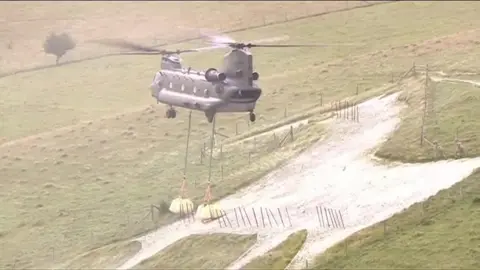
The Alton Barnes White Horse, 54m (180ft) high and 48m (160 ft) long, is the second-largest of the eight white horses in Wiltshire and was cut in 1812.
It sits in the middle of a Site of Special Scientific Interest (SSSI), which means steps have to be taken not to damage the land around it.
To ensure the site it not harmed, army helicopters have been deployed over the years to fly in tonnes of fresh chalk ahead of rechalking by local people, including school children.
Cherhill
 Greg Stoner
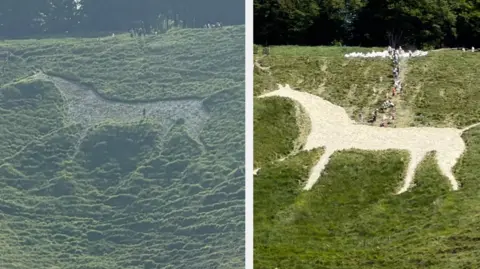
An army of volunteers came together in late May to clean up the Cherhill White Horse, which is maintained by the village with its namesake.
About 130 people formed a human chain to pass down bags of chalk after the area was weeded.
Edward, 12, was part of the Cherhill Scouts Group which helped out. He described the work as "exhausting" but "worth it".
Cherhill Parish Council owns the chalk figure and organises volunteer days each year to clean it.
Westbury
 English Heritage
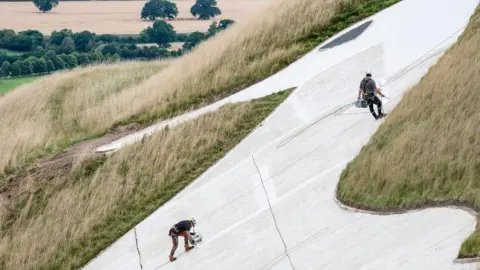
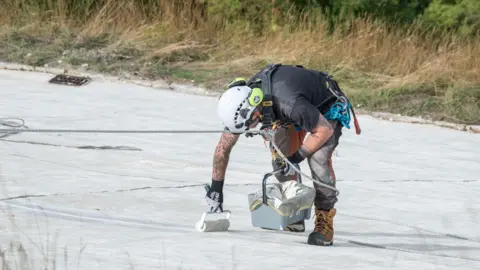
The Westbury White Horse was cut into the chalk in the late 17th Century but, in the late 1950s, was covered by white-painted concrete which soon turned grey due to its exposure to the elements.
Ruth Bean, building conservation manager at English Heritage, told BBC Wiltshire that caring for the 55m (180ft) tall White Horse "is no mean feat".
She said: "The striking local landmark is on a steep incline that gets the brunt of the westerly weather and sunshine, with the water run off the surrounding grassland causing algae to grow on and discolour the concrete horse.
"Over the years English Heritage have trialled many specialist techniques to keep the horse looking bright, with the last round of maintenance carried out in 2023.
"This was a major eight-week project which saw a team abseiling down the face of the horse to clean, repair and paint it.
"The cleaning is carried out using ThermaTech where steam is sprayed on the horse at a temperature of 150°C, sterilising the porous concrete to a depth of around 30mm."
Pewsey
 Peter Sharpe
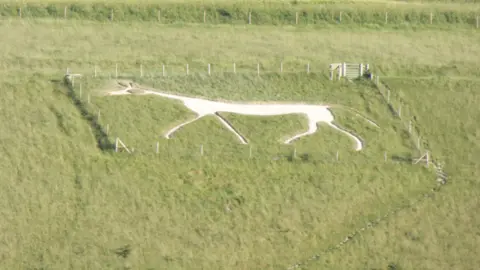
A team of volunteers come together to restore the Pewsey White Horse, which dates back to 1937.
The Parish Council is overseeing a major restoration project, with weeding completed over the last week by parents and teachers from Oare Primary School.
Peter Sharpe, from Pewsey Parish Council, previously told the BBC: "We are a village which is absolutely vibrant and we need to maintain the incredible history around it, including the white horse. It's got into disrepair which is tragic."
Hackpen
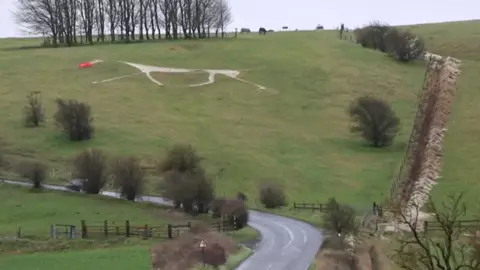
The Hackpen White Horse was created in 1838 to mark Queen Victoria's Coronation. It can be found on privately owned farmland on the Wessex Downs near to Swindon.
It is cleaned by volunteers who clear away weeds and re-whiten areas with fresh chalk. Powdered lime is also used to prevent weed growth.
In 2019, it temporarily donned a red nose to mark Comic Relief, after BBC Radio Wiltshire listeners donated red items for the occasion. The material was later recycled.
Marlborough
 Marlborough College
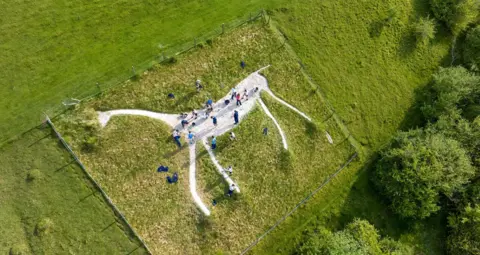
The Marlborough White Horse is located on land owned by Marlborough College, which has deployed students to the chalk creation several times throughout the years.
In 2021, it was restored by scouring, which involves re-carving the shape of the horse, digging out the design and laying new chalk to freshen up the horse.
In subsequent visits to the horse, pupils have weeded the area around the horse and cleared vegetation from its chalk surface to make it stand out more.
Roundway
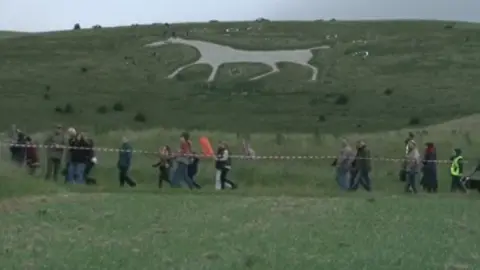
Officially named the Devizes Millennium White Horse, and also known as the Roundway or Devizes White Horse, this landmark is the newest of Wiltshire's chalk horse figures, carved into the hillside in 1999.
Found on Roundway Hill on the outskirts of Devizes, it was based off a now vanished horse known as 'Snobs Horse' in the same area.
It has previously been restored by the Probation Service Community Service Group, which supervises people who carry out unpaid work as part of a court sentence.
Local volunteers have also worked on the edges of the horse which preserves its outline and held events such as a lantern parade at the horse.
Broad Town
 Google Maps
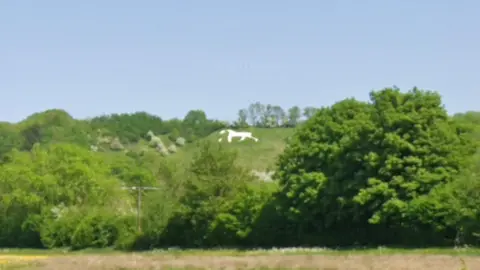
Carved into a 45-degree slope above Little Town Farmhouse, the Broad Town White Horse is thought to have been created in 1885.
The horse was neglected up until 1991 when the Broad Town White Horse Restoration Society was formed by local villagers to regularly scour and maintain the horse.
They have continued to do ever since and volunteers meet twice a year to tidy up the horse.
Follow BBC Wiltshire on Facebook, X and Instagram. Send your story ideas to us on email or via WhatsApp on 0800 313 4630.
