Stalking offences up 40% in two years, says report

 Getty Images
Stalking cases in a city have risen by 40% over the past two years, according to new figures.
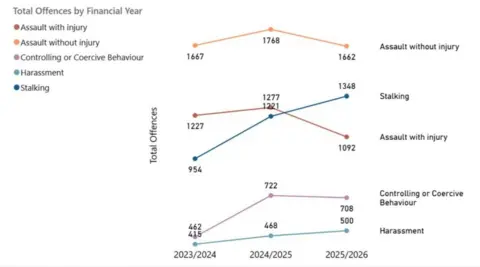
Last year, Avon and Somerset Police recorded 1,348 stalking offences in Bristol, compared to 1,221 the previous year and 954 the year before that.
The Community Safety Partnership report has revealed stalking as the second most common type of domestic abuse offence, behind assault without injury.
Police are being given extra training for investigating the crime, including spotting patterns of control, underlying behaviours and overlap with other offences.
 Bristol Community Safety Partnership
According to the Local Democracy Reporting Service, the latest figures were given to Bristol City Council's public health and communities policy committee on Friday.
This formed part of a comprehensive look at all sorts of offences in Bristol, including knife crime which has seen a reduction over the past few years.
The report also revealed that harassment offences rose from 415 in 2023–24 to 500 last year while controlling or coercive behaviour offences increased from 462 to 708.
Overall, domestic abuse offences have risen by 5% over the past two years with the highest number of offences being assault without injury, where 1,662 offences were recorded.
The sharp increase in stalking cases is reflected in a national trend which researchers have suggested could, in part, be due to the use of technology.
In March the Crown Prosecution Service launched its first Stalking Action Plan, recognising how the crime had shifted into the digital age.
This includes the use of GPS trackers, social media platforms, home surveillance, smart technology, online shopping channels and banking apps.
National stalking lead for the CPS Olivia Rose said in March: "Every day our prosecutors see lives upended, confidence shattered and safety compromised by stalking.
"We refuse to stick to the status quo while the environment this offending takes place in rapidly changes.
"As offenders find new ways to stalk and control through technology, we are determined to stay ahead of them."
Supt Deepak Kenth, who chairs the Bristol Community Safety Partnership, said stalking cases were on the rise but so, too, are convictions in court.
Follow BBC Bristol on Facebook, X and Instagram. Send your story ideas to us on email or via WhatsApp on 0800 313 4630.
