'E-pharmacy' among £100m Stormont projects

 Getty Images
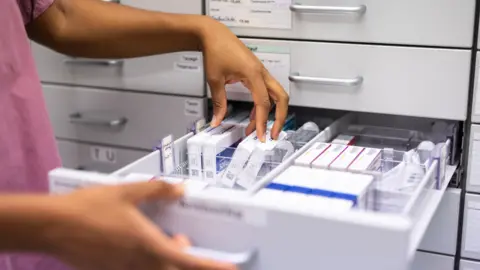
An "e-pharmacy" scheme to replace paper prescriptions is among six new Stormont projects receiving a share of more than £100m to help transform public services.
Other initiatives include investments in family support services and a cross-border research project to tackle bovine tuberculosis.
The funding is the remainder of a £235m financial package pledged by the UK government to help restore Northern Ireland's devolved institutions two years ago.
Finance Minister John O'Dowd described the announcement as an "important milestone" that would help in "placing public services on a more sustainable footing".
"These projects have significant potential to bring about lasting improvements to the way frontline services are delivered, including to some of the most vulnerable in society," he said.
The £235m financial package, known as the "transformation fund", was pledged to the Northern Ireland Executive to help restore the power-sharing government in 2024.
A first tranche of funding was allocated in March last year, with six projects earmarked to receive a share of £129m.
The money is expected to be used over a five-year period until 2029.
Stormont's Department of Health is to receive £42m for an "e-pharmacy primary care digital reform programme".
Speaking in the assembly, O'Dowd said it aims to provide a "digitisation of over 45 million prescription items issued each year".
He said it would involve "replacing paper prescriptions with a faster, safer, electronic system capable of being available 24/7 including evenings, weekends and bank holidays".
The minister said this would help pharmacies "provide more clinical services, improving access to care closer to home and reducing reliance on GP appointments".
'Long-overdue for patients and GPS'
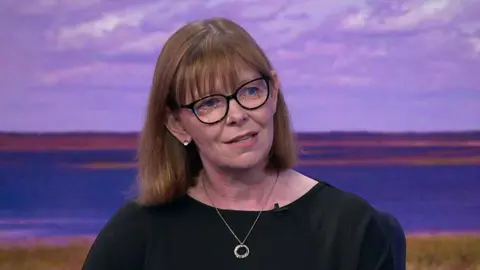
Health Minister Mike Nesbitt said that transitioning from paper prescriptions to a digital system "will genuinely transform patient experience".
But he said it could take between two to three years until patients would be able to avail of the service.
In a statement, the chair of the Royal College of General Practitioners Northern Ireland, Dr Ursula Mason, welcomed the announcement as a "long-overdue step forward for patients and GPs".
"E‑prescribing is a step change for safety, efficiency and access. It will reduce errors, streamline processes, and give patients faster, more convenient access to their medicines.
"Crucially," said Dr Mason, "it will also cut some administrative burden on GPs, freeing up valuable time to focus on patient care, where we want our efforts to be focused."
Dr Mason added that E-prescribing will also "support climate and sustainability goals by reducing paper use and cutting carbon emissions".
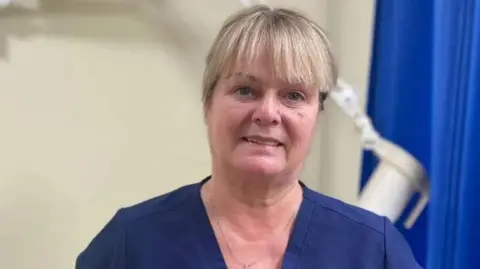
Speaking to Radio Ulster's Evening Extra programme, Chair of the Northern Ireland General Practitioners Committee (NIGPC) Dr Frances O'Hagan said Northern Ireland is "playing catch-up" with Great Britain and the Republic of Ireland.
"Its (digital prescription system) has been in place for several years in England, Scotland and Wales. And it was brought in very quickly during Covid in the Republic of Ireland."
Dr O'Hagan suggested a fully digital system would be convenient for patients and efficient for practices, as it would stop service users "clogging up phone lines" and free up doctors from "signing horrendous amounts of prescriptions every day".
"The patients wouldn't have to chase after bits of paper and ring to see if their prescription's available," she added.
The health minister has said it will be two or three years before the new system is introduced, but Dr O'Hagan said she would like to see "that timeline brought down dramatically".
"The sooner the better. If we have to wait another couple of years, it's just putting extra workload on our practices, on our receptionists, on our GPs," added Dr O'Hagan.
She also said the new system will do nothing to increase appointment capacity.
"That's a separate issue."
Which other projects have received funding?
The other projects to receive funding were:
- £29m for the Department of Health for a "together for families" project, which will involve "strengthening 29 family support hubs". The scheme is also to receive £30m from the National Lottery Community Fund.
- £16m for the Department for Communities on a "pathway to work and well-being" scheme. It aims to create a "stronger integration between employability and health services to support more people to find and sustain employment".
- £6m for a "digital workplace solution" by the Department of Finance, aimed at modernising records management across the Northern Ireland Civil Service.
- £5.3m for the Northern Ireland Statistics and Research Agency (Nisra) data linkage office to encourage a "stronger data-driven culture to provide better outcomes".
- £4m for the Department of Agriculture, Environment and Rural Affairs on a "bovine TB pilot", which involves a "regionalised research pilot to redesign control of bovine TB". The project will also receive £5.6m from the Irish government's Shared Island Fund.
O'Dowd said he would seek executive support on funding for a further five projects recommended for approval if his draft multi-year budget proposals are agreed.
Nebitt added the "together for families" project was a "once-in-a-generation opportunity to improve the life chances of children and families across Northern Ireland".
Northern Ireland secretary Hilary Benn said the transformation fund was a "clear signal of this government's commitment to supporting the executive to deliver better public services".
"At the heart of this funding is a simple goal: making public services work better for the people who rely on them every day," he added.
