Farmer to pay extra £25k on fertiliser due to Iran war

 BBC
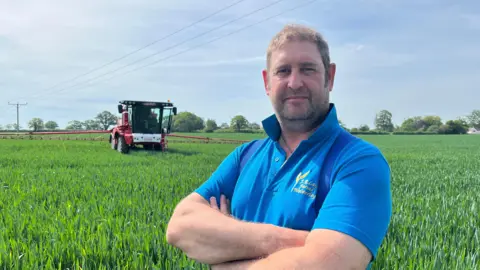
BBCA farmer who had to spend £25,000 more this year on fertiliser due to the war in Iran has said people in his industry are feeling "despondent."
The price of fertiliser has risen by around 50% since this time last year due to conflict in the Middle East restricting access to natural gas.
Rory Lay, an arable, beef and sheep farmer near Wem in north Shropshire, said his farm spent £77,000 on fertiliser in 2026, compared to £52,000 for the same quantity in 2025.
The industry is "generally despondent," Lay said, adding that "whatever item we buy, everything's gone up."
Ongoing volatility in the region and restricted access through vital shipping route, the Strait of Hormuz, means there has been "a lot of disruption within the supply" of fertiliser, Lay added.
"Even if I delay [buying] my fertiliser, hoping the price will come down, then we get to where there might not be enough supply," he explained.
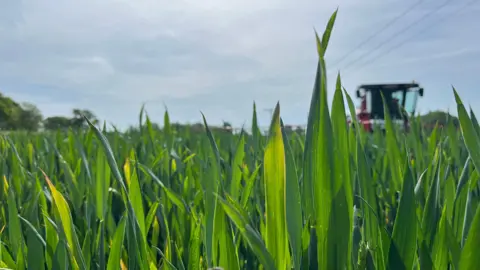
Farms like Lay's use fertiliser to encourage growth of cereal crops, as well as to grow grass for the cows and sheep to graze on.
A reduction in the amount of grass grown due to a lack of fertiliser creates "welfare issues" as farmers cannot feed their livestock, he said.
 Ellen Knight/BBC
Another issue is that farmers like Lay will not recoup the extra expense until autumn 2027 at the earliest.
This means that if prices for produce fall, they could make a loss as the fertiliser this year has been so expensive.
"It's a very long-term game," he said, adding that farmers are "trying to plan and get the best" out of their crops.
The hope is, Lay said, that the price "skyrockets" as the "world is very volatile", meaning farmers will see a return on the fertiliser investment.
'Our businesses struggle'
"Fertiliser pricing is influenced by all these factors, but it's just scary as we [farmers] can't have much influence", Lay said.
Spending that extra £25,000 means that for Lay, "it's down to borrowing a bit more money".
"So then that costs money to borrow money," he said, adding that farms have "always got things to buy", but fertiliser is "the biggest one in one go".
The news that government ministers are pressing supermarkets to reduce costs does not help, either, Lay said.
He thinks supermarkets should increase payments to farmers to enable them to produce food while absorbing the extra costs so they don't impact consumers directly.
"Really, the food prices need to go up to help us afford to grow the crops and the stock for people to eat," he explained.
"Supermarkets could easily take a couple of pence of bread, add two pence on to toilet paper, and [their profits] would see no difference at all," Lay said.
"They are the ones who set the price, and we just have to try and make our businesses struggle along."
Follow BBC Shropshire on BBC Sounds, Facebook, X and Instagram.
