Hamas can survive politically by giving up weapons and armed conflict, peace envoy says

 Reuters
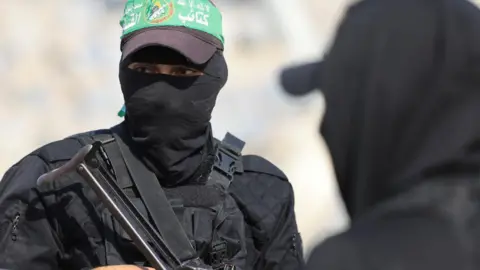
A senior diplomat tasked with implementing Donald Trump's peace plan for Gaza has said Hamas could survive as a political movement after handing over power, if it rejected armed conflict and gave up its weapons and military structures.
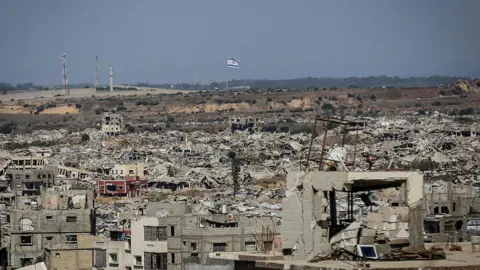
Nickolay Mladenov, high representative for Gaza to the US-led Board of Peace, speaking to journalists on a visit to Jerusalem, also warned that the current stalemate could lead to a permanent division of Gaza, along the so-called Yellow Line marking the area controlled by Israel.
"[Continuing] a status quo actually means at some point solidifying the Yellow Line, probably into a fence, probably into a wall, creating a permanent separation in Gaza," he said.
"And if anyone wants to convince me that the Palestinian people in Gaza would like to see the Gaza Strip divided in that way, I don't believe it. And if you tell me that this is security for Israel, I don't see it as well."
Donald Trump's peace plan for Gaza is currently stalled in a fractured ceasefire. Hamas is so far refusing to disarm, while Israel is regularly carrying out strikes across Gaza, and firing at those who approach the territory it holds.
 AFP
AFPPatrick Griffiths, Middle East spokesman for the International Committee of the Red Cross, told me he had heard gunfire and explosions every day while visiting the organisation's field hospital in the southern area of Rafah, close to the Israeli-held area.
"All my colleagues there had a story about going to the ground as stray bullets fly over the hospital," he told me. "They have memories of staff and patients being hit as stray bullets fly through the canvas tents of our field hospital. That's normal life for the Palestinians that live in that part of Gaza, only a few hundred metres from the Yellow Line."
Israel has been extending the area of Gaza under its effective control since the ceasefire took effect last October. In March, it marked out new areas where international organisations must co-ordinate their activities with Israeli forces.
The daily newspaper, Israel Hayom, calculated that Israeli forces now controlled 64% of the Gaza Strip, including both the 53% of the territory occupied behind the Yellow Line and areas needing co-ordination.
"Regardless of whether there is a Yellow Line, or a line transmitted to humanitarian organisations to co-ordinate movements, we need to be very clear that Israel is the occupying power in control of the entirety of the Gaza Strip," Patrick Griffiths told me.
"Its obligations under international law apply across the Gaza Strip - that means protection for civilians, regardless of how close or how far you might live as a Palestinian in Gaza."
Hamas says Israel has killed 850 people in Gaza during the ceasefire, without distinguishing fighters from civilians, severely restricted the flow of aid, and "continuously moved the Yellow Line westward".
Cogat, the Israeli defence body responsible for co-ordinating activity in Gaza, said 600 lorries of aid a day had entered since the ceasefire began. Hamas figures suggest only a third of that number entered Gaza on some days this month.
 EPA
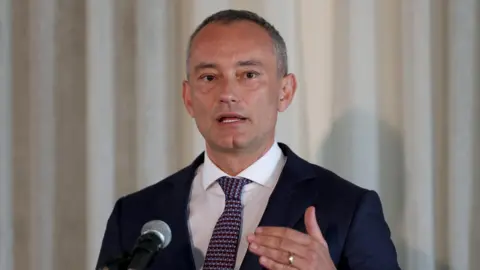
EPAMladenov said Israeli withdrawal from the territory depended on Hamas disarming and handing over power, but that the group could survive as a political party if it gave up its commitment to fighting Israel.
"We're not asking Hamas to disappear as a political movement. A political party that disavows armed activity can compete in national Palestinian elections," he said.
"What is not negotiable, however, is that armed factions or militias with their own military command and control systems, with their own arsenals or tunnel networks, can exist alongside a transitional Palestinian authority."
In response, Israel's government said the terms of the ceasefire deal state that Hamas and other factions "agree to not have any role in the governance of Gaza, directly, indirectly, or in any form".
Hamas has said it is committed to handing over power.
Mladenov said both sides now faced a choice between implementing the next step of the peace plan, or cementing Gaza's current division into a permanent separation - "probably a fence or a wall".
That was something Gaza's people would not want, he said, and which would not deliver security for Israel either.
Many believe that the current stalemate suits both Israel's leaders and Hamas - which is backed by Iran, and watching how the US-Israeli war with Iran plays out.
But some in Israel are calling for a third option - an Israeli disarmament of Hamas by force, even if that means a return to war.
