Warm spring sparks toxic caterpillar health warning

 BBC
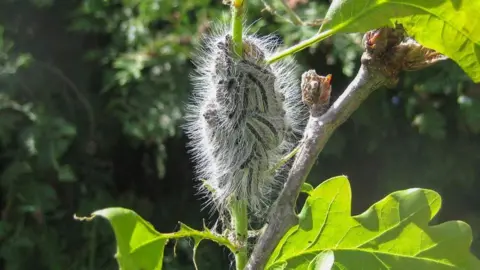
BBCThe warm spring has led to an increase in numbers of a caterpillar which has tiny toxic hairs that can trigger allergic reactions and skin irritation, the Forestry Commission has warned.
The Department for Environment, Food and Rural Affairs (Defra) said it was monitoring areas in Derbyshire and Dorset where oak processionary moth caterpillars (OPM) have been spotted.
An outbreak in Dorset last year was the furthest south-west of any known OPM infestation in England. They are generally found in the South East.
Large numbers of them can strip oak trees of their bark, which leaves them vulnerable to diseases and other pests.
The caterpillars descend down oak trees in head-to-tail procession, hence their name.
Their nests, which can be found on the trunk or the underside of branches of oak trees, also contain the toxic hairs.
Members of the public are advised never to touch them or try to dispose of them.
How to identify Oak processionary moth caterpillars
- Nests are typically dome or teardrop-shaped, averaging the size of a tennis ball.
- They are white when fresh, but soon become discoloured and brown
- The caterpillars have black heads and bodies covered in long white hairs which contain proteins which can cause itchy rashes, eye, and throat irritations
- They can also occasionally cause breathing difficulties in people and pets so should not be touched
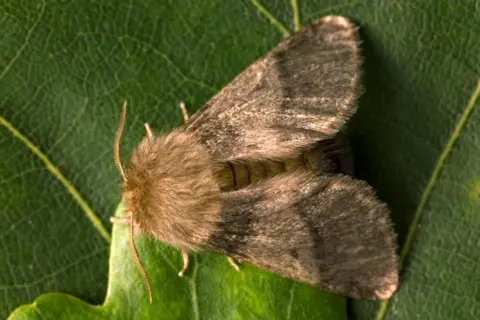
Defra said the OPM had been confirmed in an area of Dorset free from the pest in 2025, with 30 infested trees identified.
"The area was extensively surveyed to understand the scale of the outbreak and control measures applied, including robust treatment of the infested trees," it said.
"Extensive outbreak management and surveillance work, including treatment, ground surveys and pheromone trapping, will continue in the regions throughout 2026."
It said "robust action" would be taken with the "aim of eradicating the pest from the area".
"All infested trees identified are met with rapid, intensive, eradication response action, this can include treatment and nest removal."
Warm weather
Defra added it was important those living and working in areas affected by the OPM remained "vigilant".
It said "rigorous surveillance" was undertaken at the Derbyshire and Dorset sites, and the Forestry Commission would continue to monitor them throughout 2026,
Dr Edward Straw, Forestry Commission oak processionary moth programme manager, warned that there could be "higher infestation levels" this year because of the warm weather.
According to the Met Office, 2026 is the warmest spring on record for England.
The Forestry Commission also said eggs hatched in central London on 24 March, a week earlier than last year.
Prof Nicola Spence, chief plant health officer with Defra, said: "I would advise that members of the public living in the South East, Derbyshire and Dorset, avoid any contact with the caterpillar and its nests, as this can cause irritation."
The Forestry Commission has made available an interactive map showing the locations of recent confirmed reports of the caterpillar.
It is asking people to report sightings through its TreeAlert portal including a photo and location.
The moth was first identified in London in 2006 after being accidentally transported over from Europe in trees for planting.
A decision to spray woodland in Berkshire with bacteria from the air to eliminate the toxic caterpillar following an outbreak in 2012, caused controversy over fears of the effect on other wildlife.
