


Meagre pensions
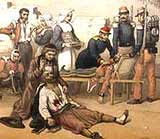
In 1661, memories of the Civil War were fresh, and the use of troops to enforce unpopular policies had been greatly resented. While the Royal Navy was regarded as crucial for the protection of British trade - and even this did not save it from peacetime reductions - the army was tolerated only when there was a war in which British interests were clearly involved.
'... the army that had helped beat Napoleon was reduced following allied victory at Waterloo in 1815.'
It was sharply reduced when the war was over, with its soldiers discharged, sometimes reduced to begging for a living or living on a meagre pension. Even the officers were sent home on a half-pay that was often pitifully inadequate. Sergeant Thomas Jackson of the Coldstream Guards was invalided out of the army after losing a leg at Bergen-op-Zoom in Holland in 1814. He appeared before the commissioners of the Royal Hospital at Chelsea, who:
'... eyed me up and down and seemed to consult for a moment, and then one of them said. "Oh, he is a young man, able to get his living". No questions asked of me, but at sight I was knocked off with the pitiful reward of a shilling a day - a mighty poor recompense, I thought, for having spent twelve years of the prime of my manhood in the service of my country ...
'Having then no more use for my scarlet coat, I set my wife to cut off the lace [round the button holes], and that, together with the chain and tassels which ornamented my cap, she sold for thirty shillings. I then bought myself a suit of plain clothes to hobble my way home with into a new sphere of life among new beings, and, as it were, into a new world again.'
The Rambling Soldier, Roy Palmer (Sutton, 1985)
This pattern marked the 18th century, with its wars against France, described by Sergeant Roger Lamb of the 23rd Foot, who served in the American War of Independence, as ‘for many ages the professed and natural enemy of Britain’. It continued into the 19th, when the army that had helped beat Napoleon was reduced following allied victory at Waterloo in 1815.
Much the same thing occurred in the 20th century, with a small peacetime army expanded to meet the demands of two world wars and reduced in their aftermath.
Published: 2005-02-28

