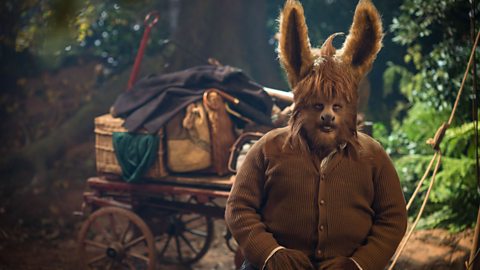
The form of William Shakespeare's A Midsummer Night's Dream
The form of A Midsummer Night’s Dream is a Shakespearean comedy. It is different from a contemporary idea of comedy – a Shakespearean comedy blends romance, mistaken identity, and playful disorder. Unlike the darker A type of drama in which characters undergo suffering or calamity and which usually ends with a death. A sad or catastrophic event causing suffering or death., this comedy embraces chaos, magic, and humour to reveal the irrational nature of human desire. The play moves between three contrasting worlds: the court in Athens, the fairy realm and the group of amateur actors; each contributing to the play’s themes of love and imagination.
Although the play is light-hearted, Shakespeare includes moments of conflict and emotional tension. Hermia faces the threat of death or lifelong chastity if she refuses to marry Demetrius, and in the forest the lovers’ quarrels are at times cruel and verge on heartbreak. However, tragic consequences are avoided. Instead, he uses these conflicts to highlight the unpredictability of love and how emotions can change. The magical interference of Puck and Oberon transforms the lovers’ relationships, at first mischievously, but ultimately to guide them toward harmony and mutual understanding.
The play also draws on the tradition of a genre of drama characterized by a, turning upside down of social hierarchy, gender roles, and conventions. It is closely tied to holiday celebrations.. This form celebrates breaking rules, disguise and temporary freedom. The enchanted forest becomes a space where normal rules are suspended, allowing characters to explore desires they cannot express in the rigid Athenian court. At the end, the three weddings demonstrate a return to stability and order.
Shakespeare includes a play‑within‑a‑play in the Mechanicals’ performance of Pyramus and Thisbe. This comic subplot parodies tragic drama, exaggerating its conventions for humorous effect. It also reflects the play’s wider interest in performance, illusion and the blurred line between reality and imagination. The Mechanicals’ earnest but clumsy attempt at theatre contrasts with the effortless magic of the fairies.
By blending romance, comedy and the supernatural, Shakespeare creates a world where dreams and reality overlap.
The structure of William Shakespeare's A Midsummer Night's Dream
Structure refers to how the events in the play are ordered and presented. The The way the poet has organised the poem on the page eg number of stanzas, lines per stanza, breaks in between lines and stanzas. of A Midsummer Night’s Dream takes the audience on a journey from order into chaos and then back to harmony. Shakespeare organises the play so that events move between the strict, rule‑bound world of Athens and the unpredictable, magical world of the forest. The action unfolds in a mostly chronological order, but the dream‑like atmosphere of the forest makes time feel fluid and uncertain. The play takes place over a single night, which gives the structure a tight, dream‑like quality and emphasises how quickly emotions can change.
Shakespeare opens the play with a problem that challenges the stability of the Athenian court and society: Hermia must choose between obeying her father, or facing death or a life in a convent. Structurally, this moment acts as a trigger for the rest of the play, pushing the lovers into a magical setting where normal rules no longer apply. The audience is introduced to the forest, a place of transformation, illusion and emotional upheaval.
In the forest, Shakespeare presents three storylines that run alongside one another. Firstly, the lovers’ confusion and changing affections; secondly, the quarrel between Oberon and Titania; and thirdly, the comic subplot involving Bottom and the Mechanicals rehearsing their play. These different storylines overlap and interact, sometimes echoing each other. For example, the lovers, Titania, and one of the Mechanicals, Bottom, all fall victim to magical interference, showing the confusion and irrationality of love. The Mechanicals’ scenes provide comic relief and also mirror the play’s theme of performance and mistaken identity.
The central section of the play is dominated by chaos. Puck’s mistakes intensify the confusion, and characters chase one another through the forest in a series of rapid, energetic scenes. This fast‑paced structure reflects the instability of emotions and the unpredictable nature of magic. The disorder reaches its peak when Hermia, Helena, Demetrius and Lysander are all under the influence of the love potion, creating a comic but tense climax.
The final acts restore order. Oberon reverses the magic, and the lovers are paired correctly. Three marriages take place and this sense of resolution would have been pleasing to the audience of the time. The play also draws on the tradition of a genre of drama characterized by a, turning upside down of social hierarchy, gender roles, and conventions. It is closely tied to holiday celebrations.. This form celebrates breaking rules, disguise and temporary freedom. The enchanted forest becomes a space where normal rules are suspended, allowing characters to explore desires they cannot express in the rigid Athenian court. At the end, the three weddings demonstrate a return to stability and order.
The play ends with a sense of closure: conflicts are resolved, relationships are repaired, and the return to Athens indicates stability.
Language and dramatic techniques in A Midsummer Night's Dream
When studying a play and in preparation for your controlled assessment, you must consider both language features and dramatic techniques. It is important that you consider their effect – don’t just identify or name them.
Below are some language (or linguistic) features and dramatic techniques that you will come across in A Midsummer Night’s Dream.
Language features
Imagery
Imagery is language that creates pictures in the audience’s mind. It appeals to the senses (sight, sound, touch, taste, smell). Shakespeare uses several types of imagery in A Midsummer Night’s Dream, some of which are considered below along with their effects.
Light and dark imagery
The play is set over a night so understandably there are many references to night and darkness, such as Hermia’s comment “Dark night, that from the eye his function takes”. However, in the midst of darkness, Shakespeare has provided a natural source of light – the moon. There are multiple references to moon imagery throughout the play, “By moonlight” / “Moonshine”, “The moon… wanes”, “the moon… looks with a watery eye”.
The effect of the references to the moon can be either to create a dream‑like and magical setting, but also reflect changeability and instability.
Floral imagery
In Act 2, Scene 1, Oberon describes Titania’s resting place:
I know a bank where the wild thyme blows,
Where oxlips and the nodding violet grows,
Quite over-canopied with luscious woodbine,
With sweet musk-roses, and with eglantine
The effect of the floral imagery shows the lush world of the forest, which contrasts with the urban world of Athens. Flowers are beautiful and delicate – these could be seen to represent love.
Magic
There are numerous references to magic, enchantments, and charms in A Midsummer Night’s Dream, such as: “upon thy eyes I throw / All the power this charm doth owe”.
The effect of this language and imagery is to show how changeable love can be, as if controlled by unseen forces.
Love imagery
As one of the main themes of the play, there are many references and images of love. For example, “My heart to hers is knit” (Lysander, Act 2, Scene 2) and “Love looks not with the eyes, but with the mind” (Helena, Act 1, Scene 1).
The effect of these is to show deep emotional commitment and the power of love.
Dream and illusion
When the characters enter the forest, they enter a world of dream and illusion. This is supported by imagery such as “I had a dream, past the wit of man to say what dream it was…” (Bottom, Act 4, Scene 1) and “That you have but slumbered here / While these visions did appear.” (Puck, Act 5, Scene 1).
The effect of these is to blur the lines between reality and fantasy, helping the audience accept the strange events and reflecting the uncertain nature of love.
Comic language
Shakespeare uses The incorrect use of a word by mistake which sounds similar to the target word, often with humorous effect. (misused words) and exaggerated phrasing in the Mechanicals’ scenes. Bottom’s attempts at poetic language are deliberately clumsy and create humour. Bottom’s name is also a A play on words, relying on similar sounding words or two meanings of one word. as he literally becomes an ass.
The effect of this language is to create humour and provide comic relief from the grander themes of love, identity and social order.
Prose and verse
Shakespeare wrote his plays in both Ordinary language both spoken or written; different from poetry (which does not reflect everyday speech patterns). and verse, using each Some poems adopt specific 'forms'. For example, they could be sonnets or narrative poems. Many don’t have an identifiable form. for a particular reason. Most of Shakespeare’s plays are written in verse, and prose is used strategically.
Use of verse
One ‘iamb’ is a two-beat combination: an unstressed syllable followed by a stressed (emphasised) syllable, making a ‘da-DUM’ pattern, like a heartbeat. Pentameter means five of these two-beat units per line, making ten syllables altogether is unrhymed Lines in a poem that don't rhyme, usually in iambic pentameter - five two-syllable feet per line.. There are ten syllables (or beats) in each line, following a pattern of unstressed and stressed syllables (da‑DUM) repeated five times. Iambic pentameter was used as it reflects natural speech, but it also gave a sense of authority and elevation to the words.
The effect of iambic pentameter in A Midsummer Night’s Dream gives the play a formal, elevated tone suitable for the serious topics and the nobility of the court of Athens. An example of this is Egeus’ speech to Theseus at the beginning of the play:
I beg the ancient privilege of Athens:
As she is mine, I may dispose of her,
Which shall be either to this gentleman
Or to her death, according to our law
Immediately provided in that case.
(Act 1, Scene 1)
Rhyming couplets
In poetry, a pair of lines that rhyme and have the same length and metric pattern. are two consecutive lines which rhyme. They are often used by Shakespeare to indicate the end of a speech or scene giving it a sense of completion. In A Midsummer Night’s Dream, Shakespeare also uses rhyming couplets as the language of the fairies:
That you have but slumber’d here
While these visions did appear.
And this weak and idle theme,
No more yielding but a dream
(Act 5, Scene 1)
This language is musical and magical and the effect is spell‑like, setting the fairies apart from the humans in the play.
Use of prose
Shakespeare used prose to indicate a lower‑class character, to demonstrate emotional instability and for letters. In A Midsummer Night’s Dream the mechanicals speak in prose, for example “Masters, you ought to consider with yourself, to bring in (God shield us!) a lion among ladies a most dreadful thing.”
The effect of this is to show their status and contrast with the nobility and the magical beings.
Dramatic techniques
Remember that plays are written to be performed; therefore you should use the term ‘audience’ and not ‘reader’.
Setting
Shakespeare has chosen to set the play in two contrasting settings – the formal and structured world of Athens and the magical and chaotic world of the forest. The effect of both settings is to allow for chaos to explore the complex issue of love but revert to order at the end. It also allows the audience to experience and question the difference in reality and illusion.
Dramatic irony
When the audience knows something that the characters don’t. is a technique where the audience knows something important that the characters on stage do not. This creates tension, humour, or a sense of inevitability because the audience can see the truth while the characters remain unaware.
For example, the audience knows Bottom has an ass’s head, but he doesn’t. “What do you see? You see an ass-head of your own, do you?”.
The effect of this is to create humour but also to emphasise the theme of love’s blindness as Titania falls in love with him (although it has to be pointed out she is under a spell!).
Breaking the fourth wall
This dramatic technique describes when a character directly addresses the audience. This happens at the end of A Midsummer Night’s Dream when Puck speaks directly to the audience:
So good night unto you all.
Give me your hands, if we be friends,
And Robin shall restore amends.
(Act 5, Scene 1)
The effect of this is to directly engage the audience as participants and perhaps make them feel as if they have been part of the dream and a strange experience. It also has the effect of providing structural closure at the end of the play as well as reinforcing Puck’s mischievous nature.
Soliloquy
A soliloquy is a speech delivered by a character alone on stage. It reveals their true thoughts, motives and feelings directly to the audience. As no other character can hear these words, this creates dramatic irony – the audience are privy to information which the other characters are not.
In Act 1, Scene 1, Helena laments that Demetrius does not return her love:
How happy some o’er other some can be!
Through Athens I am thought as fair as she.
But what of that? Demetrius thinks not so.
The effect of this soliloquy is to show Helena’s feelings and the extent of her emotional distress.
The play-within-the-play
This dramatic method draws awareness to theatrical The type of play Shakespeare is writing — such as tragedy, comedy or history — and the key features that come with that form, including being written for performance through dialogue, character interaction and theatrical techniques.. In A Midsummer Night’s Dream the mechanicals perform ‘Pyramus and Thisbe’.
The effect of this is to reflect the play’s interest in performance and illusion as well as providing a humour contrast to the lovers’ earlier emotional turmoil.
Test your knowledge of A Midsummer Night’s Dream
Further study
The study of Shakespeare, controlled assessment guidance. activity
Unit 3 of the CCEA GCSE English Literature qualification is a controlled assessment unit based on the study of a play by William Shakespeare.
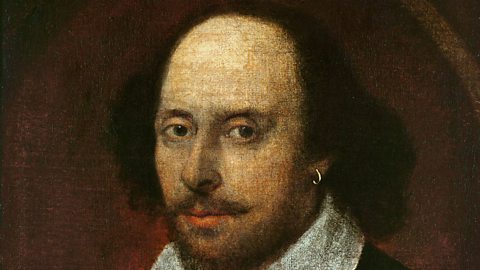
Shakespeare Unlocked - A Midsummer Night’s Dream. collection
Three key scenes from A Midsummer Night's Dream are performed and explored by actors and directors in workshops.
In Our Time. audio
Melvyn Bragg and guests discuss the ideas behind Shakespeare's comedy with its intertwining plots of royal marriage, crossed lovers, quarrelling fairies and rude mechanicals.
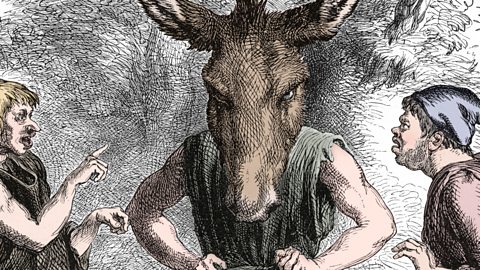
A Midsummer Night's Dream performed
A Midsummer Night's Dream. video
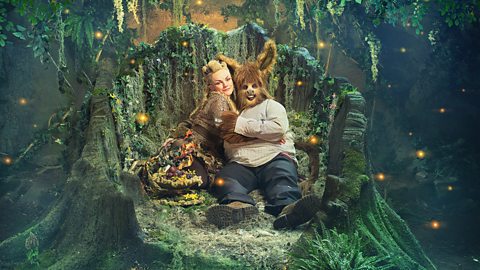
Classic Shakespeare play adapted for television by Russell T Davies.
KS3 English: A Midsummer Night's Dream by William Shakespeare. collection
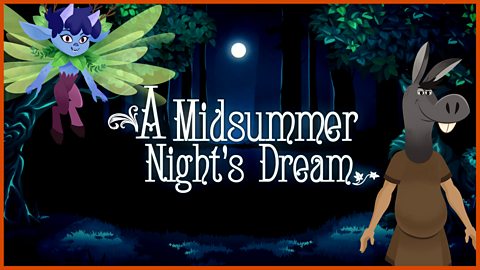
Shakespeare's romantic comedy A Midsummer Night's Dream is animated in 8 episodes for KS2 and KS3 pupils.
CBeebies: A Midsummer Night's Dream. video
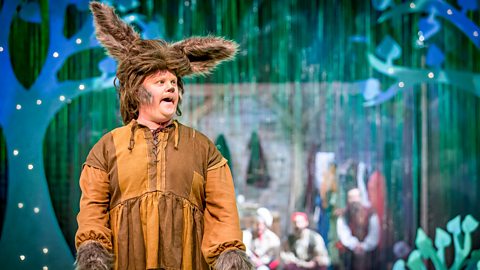
Fairies, magic, celebration and comical confusion! Join Swashbuckle's Cook and Line as they help William Shakespeare put together a magical production of A Midsummer Night's Dream.
More on A Midsummer Night’s Dream
Find out more by working through a topic
- count1 of 5
- count2 of 5
- count3 of 5
- count4 of 5