Key points
- Love is shown as powerful but often unrealistic and based on illusion rather than reason.
- Disguise and mistaken identity drive the comedy and confusion, especially through Viola.
- Gender roles are challenged, suggesting gender can be a performance, rather than something that is fixed.
- Appearance often hides reality, leading many characters to misunderstand one another.
- Ambition and social class, particularly through Malvolio, can cause self-deception and harm.
Love and desire
Love and desire in Twelfth Night are presented as powerful but often unrealistic and self‑focused emotions. Orsino opens the play by indulging in his own feelings, declaring, “If music be the food of love, play on,” which immediately establishes love as something he enjoys performing rather than truly understanding. His attraction to Olivia is based on distance and imagination rather than real interaction. Likewise, Olivia’s sudden love for Cesario demonstrates how desire can be impulsive and based on appearances rather than reality.
Shakespeare shows that love is rarely rational. Olivia claims she will mourn her brother for seven years, yet quickly abandons this promise when she meets Cesario. This suggests that desire can override social rules and previous intentions. Viola’s love for Orsino is deeper and more thoughtful, but she must conceal it, highlighting how true love typically requires patience and self-control.
Through these contrasts, Shakespeare presents different kinds of love: selfish, romanticised passion; impulsive attraction; and loyal, selfless affection. By the end of the play, order is restored and marriages resolve confusion, but Shakespeare leaves the audience aware that love is unpredictable and often born from illusion rather than reason.
Identity and disguise
Identity and disguise drive much of the action and comedy in Twelfth Night. Viola’s decision to disguise herself as a man allows her to survive in Illyria, but it also creates confusion and misunderstanding. She openly acknowledges the problem of her hidden identity when she states, “I am not what I am.” This disguise affects how others perceive her and forces the audience to consider how easily identity can be shaped by outward appearance.
Orsino trusts Cesario and values him, demonstrating that character matters more than gender, even though Orsino believes Cesario is male. Olivia’s attraction to Cesario further shows how disguise alters relationships and leads to mistaken identity. The arrival of Sebastian later in the play deepens this confusion, as characters struggle to distinguish between appearance and reality.
Shakespeare suggests that identity is not fixed. Viola adapts to different roles, proving intelligent, sensitive, and brave regardless of costume. At the same time, characters such as Malvolio reveal their true identities when they believe their circumstances have changed. Disguise therefore becomes a tool to reveal, rather than hide, true character. Through comedy, Shakespeare questions how well people really know one another when judgement relies on surface appearances.
Gender roles
Gender roles are challenged throughout Twelfth Night, particularly through the character of Viola. By dressing as a man, Viola successfully performs a male role in society, gaining freedom, respect and mobility. It must be remembered that there were very distinct gender roles at that time, and men had more rights and power than women. Viola (in the role of Cesari) is able to get a job with Orsino. She serves Orsino competently and speaks with confidence, suggesting that intelligence and capability are not limited by gender. Her disguise questions traditional expectations of female passivity.
Viola’s situation also creates emotional conflict. She loves Orsino but cannot express her feelings openly. Ironically, while disguised as a man, she becomes the object of Olivia’s desire, further blurring gender lines.
Shakespeare complicates gender further through dialogue. Orsino describes Cesario as having “all is Looking like something else or having a similar appearance. a woman’s part,” suggesting that femininity and masculinity are not strict opposites. The play implies that gender is, to some extent, a performance shaped by clothing and behaviour rather than biology. The primary purpose of the gender confusion in this play is for comedic purposes.
By the end of the play, traditional gender roles are restored through marriage; however, the audience has seen how easily those roles were disrupted. Shakespeare therefore invites reflection on whether social rules about gender are natural or simply accepted conventions.
Appearance vs reality
The contrast between appearance and reality is a central theme in Twelfth Night. Many characters judge others based on what they seem to be, rather than who they truly are. Viola’s disguise creates the most obvious example, as Olivia mistakes her for a man and falls in love with her appearance rather than her identity.
Malvolio’s storyline also explores this theme. He assumes that Olivia secretly loves him because of the letter he finds, failing to question its reality. Convinced of his imagined importance, he fantasises aloud, “To be Count Malvolio!” His belief in appearances over truth leads to his humiliation and confinement, showing the dangers of self-deception.
Even Orsino is guilty of confusing appearance with reality. He believes himself a devoted lover, yet his love is shallow and theatrical. It is only when Viola’s true identity is revealed that he begins to understand genuine affection.
Shakespeare uses comedy to highlight how easily people are misled. Those who trust appearances are fooled, while those who question and reflect, like Viola, survive and succeed. The play ultimately suggests that reality is often hidden beneath surfaces, and true understanding requires insight rather than assumption.
Social class and ambition
Social class and ambition are explored most clearly through Malvolio. As Olivia’s steward, he occupies a position of responsibility but secretly desires greater status. His ambition becomes obvious when he dreams of marriage and authority, imagining himself commanding others, including Sir Toby. His excitement at this possibility reflects how power and class can distort judgement.
Malvolio’s belief that Olivia loves him reveals his misunderstanding of social boundaries. Shakespeare uses this to criticise ambition that is driven by pride rather than merit. Malvolio’s rigid behaviour and lack of humour contrast with the carefree attitudes of Sir Toby and Sir Andrew, who flout social rules without consequence.
At the same time, the play questions whether class truly reflects worth. Though Sir Toby is noble, he behaves irresponsibly, while Malvolio, though lower in status, is efficient and serious. The prank played on Malvolio is cruel, suggesting that those in higher social positions often abuse their power.
Shakespeare does not offer a simple answer but shows that ambition can be both understandable and dangerous. When desire for status replaces kindness and self-awareness, it leads not to success, but to isolation and resentment.
Test your knowledge of the themes in Shakespeare's Twelfth Night
Further study
The study of Shakespeare, controlled assessment guidance. activity
Unit 3 of the CCEA GCSE English Literature qualification is a controlled assessment unit based on the study of a play by William Shakespeare.
In Our Time - Twelfth Night, or What You Will. audio
Melvyn Bragg and guests discuss one of the great comedies of world literature.
Opening Lines - Twelfth Night audio
John Yorke explores one of Shakespeare's best loved comedies, Twelfth Night

Twelfth Night performed
Drama on 4. audio
A 400th anniversary production of Shakespeare's wonderful comedy of mistaken identities and unrequited love, starring Toby Jones as Malvolio and Giles Terera as Orsino.

KS3 English Literature. revision-guide
An animated version of William Shakespeare’s Twelfth Night in a retelling of the classic play set to modern music.
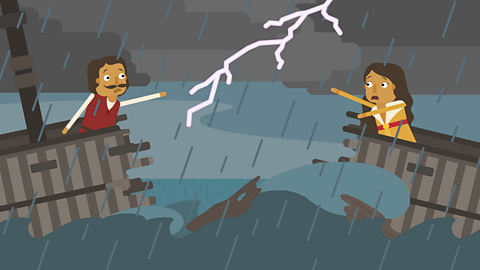
CBeebies Twelfth Night at Shakespeare's Globe. video
A host of CBeebies stars and actors take to the world’s most famous stage to perform William Shakespeare’s Twelfth Night.

More on Twelfth Night
Find out more by working through a topic
- count4 of 5
- count5 of 5
- count1 of 5
- count2 of 5