Key points
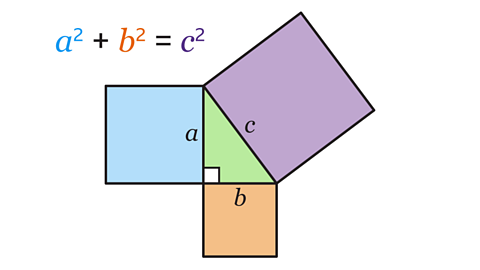
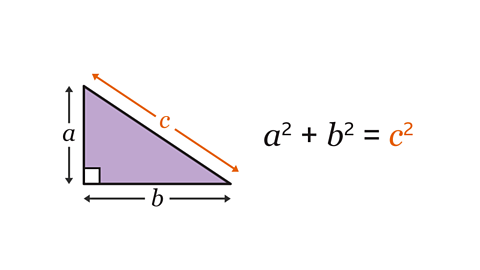
- Pythagoras’ theorem states that for any right-angled triangle, the area of the square on the The longest side of a right-angled triangle, which is always opposite the right angle. When labelling a length as the hypotenuse, it can be shortened to 𝒉. is equal to the sum of the areas of the squares on the other two sides.
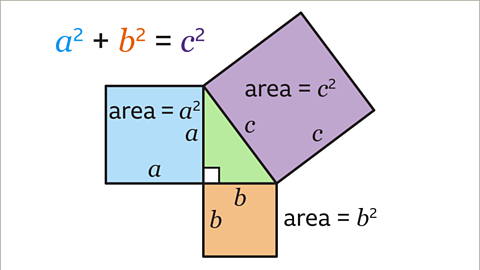
- It can be thought of as \(a\)² + \(b\)² = \(c\)² where \(a\) and \(b\) are the shorter sides of the triangle, and \(c\) is the hypotenuse (longest side).
- Pythagoras’ theorem is only true for right-angled triangles. It is possible to check if a triangle is right-angled byIn algebra substitute means to replace a letter (or variable) with a number. in the lengths of the sides and seeing if the value of \(a\)² + \(b\)² is the same as the value of \(c\)².
- Pythagoras’ theorem can be used to find a missing side of a right-angled triangle. To find the hypotenuse, In algebra substitute means to replace a letter (or variable) with a number. the values of \(a\)² and \(b\)² into the equation, and solve to find \(c\). This will involve adding the two squares and finding the A value that, when multiplied by itself, gives the number. Eg, 4 × 4 = 16, so the square root of 16 is 4. √16 = 4 of the answer.
- To find a shorter side, substitute the values into the equation and solve to find \(a\) or \(b\). This will involve subtracting the two squares and finding the square root of the answer.
- An understanding of powers and roots is essential before exploring this topic.
What is Pythagoras' theorem?
Pythagoras’ theorem is a statement that is true for all right-angled triangles.It states that the area of the square on the The longest side of a right-angled triangle, which is always opposite the right angle. When labelling a length as the hypotenuse, it can be shortened to 𝒉. is equal to the sum of the area of the squares on the other two sides.
It is useful to think of Pythagoras’ theorem as \(a\)² + \(b\)² = \(c\)².
The hypotenuse is labelled as \(c\) and the other two sides labelled as \(a\) and \(b\). This makes the areas of the squares \(c\)², \(a\)² and \(b\)².
Examples
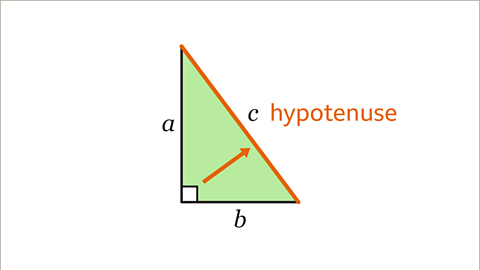
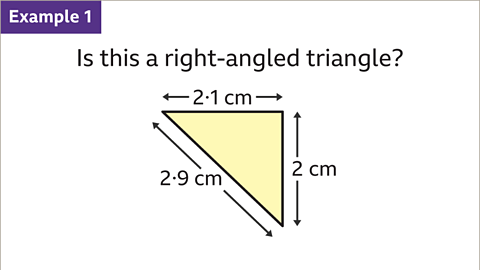
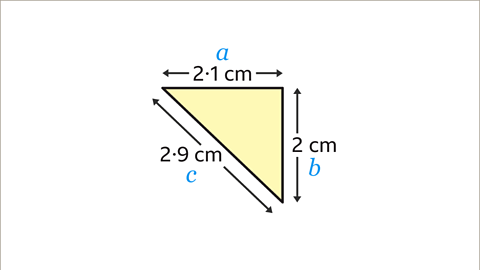
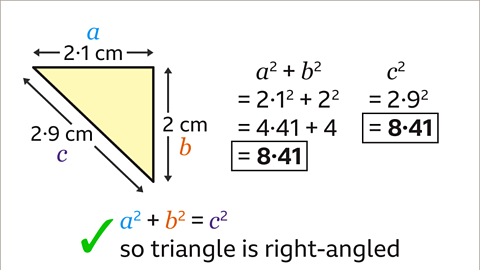
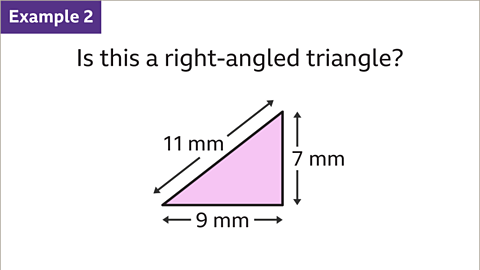
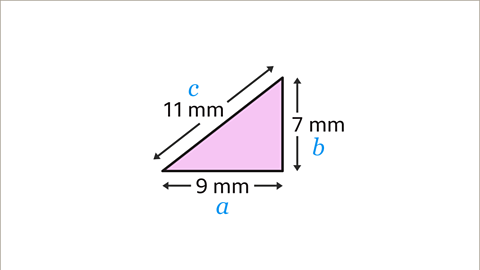
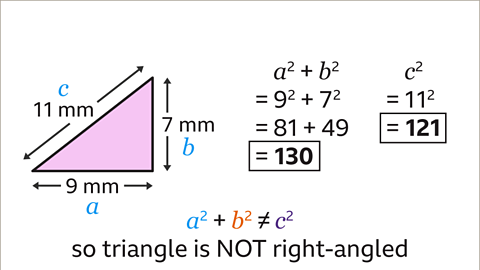
Image caption, The hypotenuse is the longest side of a right-angled triangle. It is always opposite the right angle. To label a right-angled triangle to use Pythagoras’ theorem, the hypotenuse should be labelled as 𝒄. The other two sides should be labelled 𝒂 and 𝒃. It does not matter which way round 𝒂 and 𝒃 are labelled.
1 of 10
Question
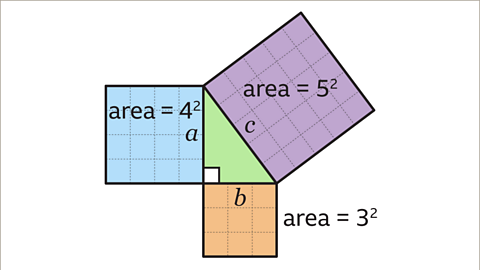
Show that the triangle is a right-angled triangle using Pythagoras’ theorem.
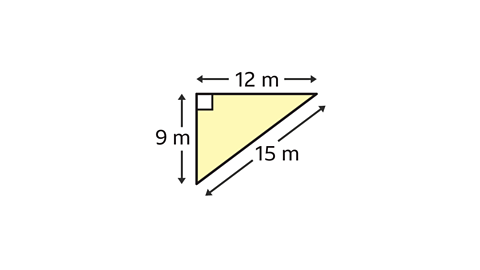
For a triangle to be right-angled, it must satisfy Pythagoras’ theorem:
\(a\)² + \(b\)² = \(c\)².
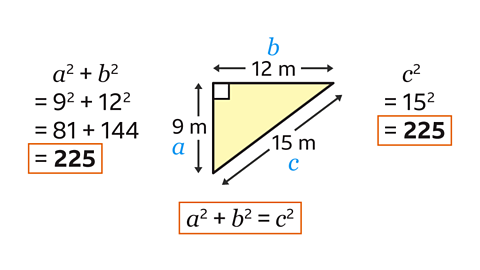
Label the sides \(a\), \(b\) and \(c\). \(c\) is the hypotenuse, which is the longest side. It does not matter which way round \(a\) and \(b\) are labelled.
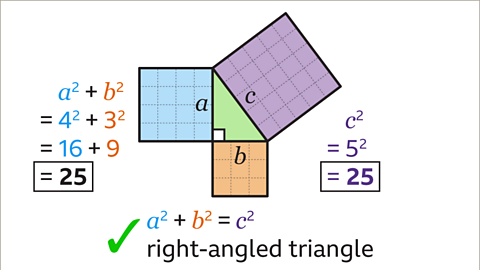
\(a\)² + \(b\)² = 9² + 12² = 81 + 144 = 225
For the triangle to be right-angled, the value of \(c\)² must also be 225. The value of \(c\)² is 15² = 225
The value of \(a\)² + \(b\)² Is the same as the value of \(c\)². Therefore, the triangle is right-angled.
Finding the length of the hypotenuse
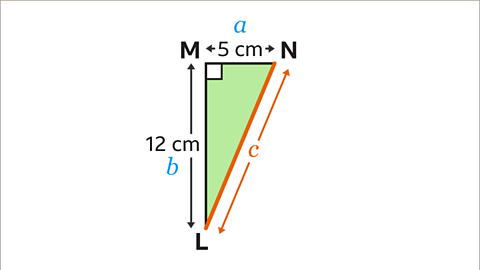
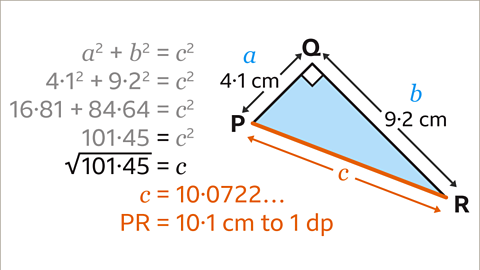
Pythagoras’ theorem states the relationship between sides in a right-angled triangle. It states that 𝒂² + 𝒃² = 𝒄², where 𝒄 is the hypotenuse (longest side), and 𝒂 and 𝒃 are the other two sides. can be used to calculate a missing side in a right-angled triangle. Follow these steps to find the length of the The longest side of a right-angled triangle, which is always opposite the right angle. When labelling a length as the hypotenuse, it can be shortened to 𝒉. when the other two sides are given.
Label the sides \(a\), \(b\) and \(c\). Remember, the hypotenuse should always be labelled \(c\).
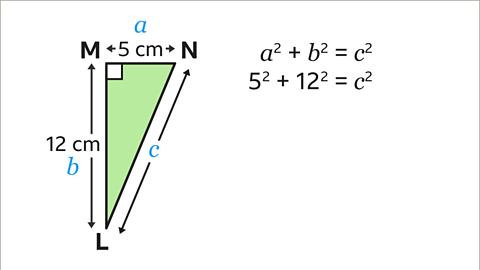
Then In algebra substitute means to replace a letter (or variable) with a number. the values of \(a\) and \(b\) into the equation \(a\)² + \(b\)² = \(c\)².
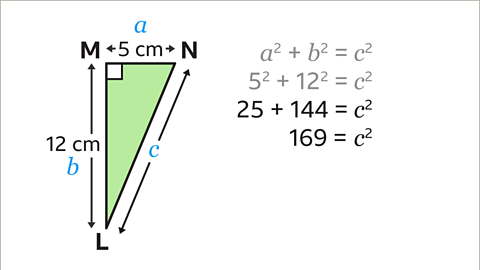
Add the squares together to get the value of \(c\)².
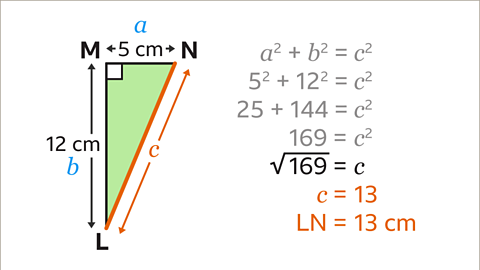
Square root the value of \(c\)² to get the value of \(c\).
Examples

Image caption, Find the length of LN
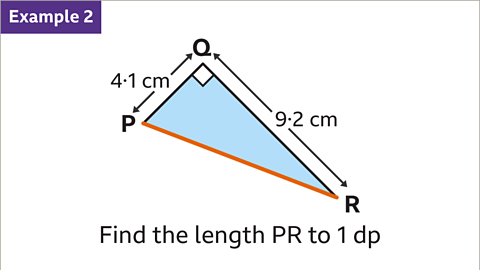
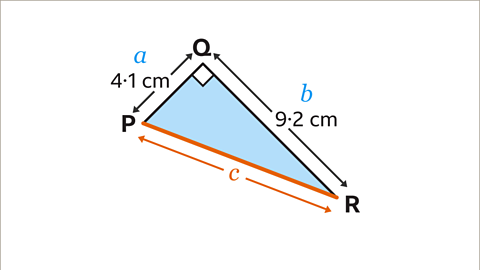
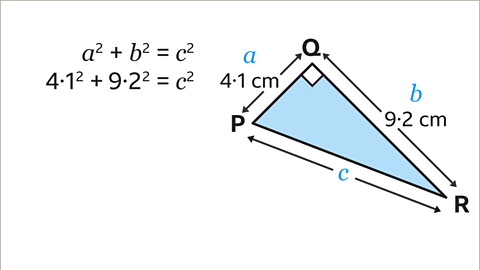
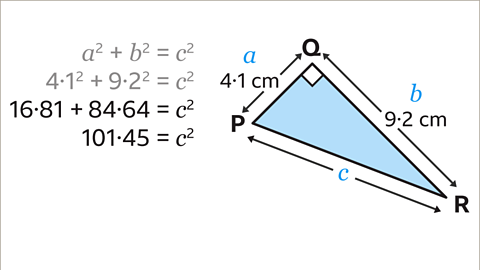
1 of 10
Question
Find the length ST to 1 decimal place.
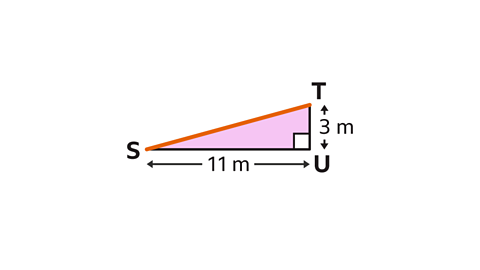
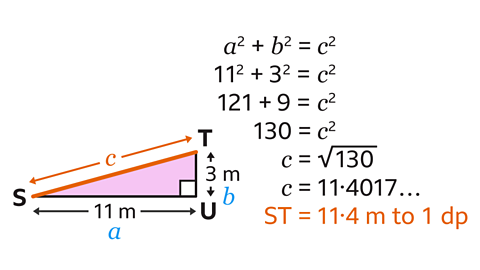
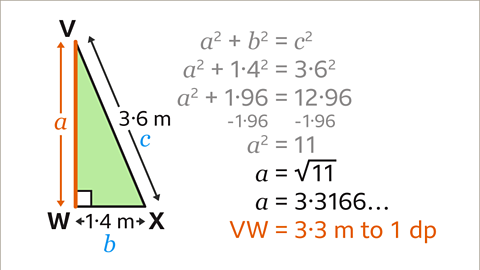
ST is the length from S to T. ST is the hypotenuse, so should be labelled as \(c\). 11 m can be labelled as \(a\) and 3 m can be labelled as \(b\).
Substitute these values into \(a\)² + \(b\)² = \(c\)² to give 11² + 3² = \(c\)².
11² is 121. 3² is 9
Add the two squares together to give \(c\)² = 130
To find \(c\), the inverse of squaring is square rooting, so \(c\)=√130 = 11.4017…
When rounded to 1 decimal place, this gives ST = 11.4 m.
Finding the length of another side
Follow these steps to find the length of a side that is not the hypotenuse.
Label the sides \(a\), \(b\), and \(c\). Remember the The longest side of a right-angled triangle, which is always opposite the right angle. When labelling a length as the hypotenuse, it can be shortened to 𝒉. should always be labelled \(c\)
Then In algebra substitute means to replace a letter (or variable) with a number. the values of \(a\) and \(b\) into the equation \(a\)² + \(b\)² = \(c\)²
If finding \(b\), subtract the squares to get the value of \(b\)²
Finally, A number whose square is equal to the given number, √9 = 3, 3² = 9. The value may also be negative, eg (-3)² = 9 the value of \(b\)² to get the value of \(b\)
Examples
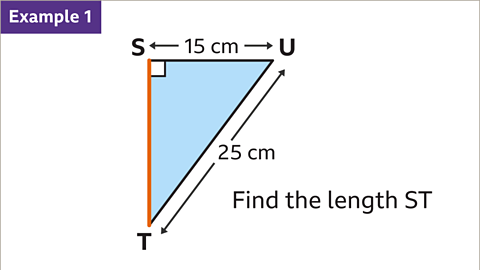
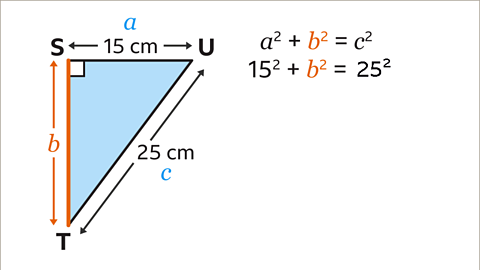
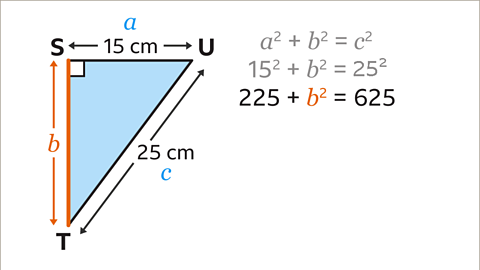
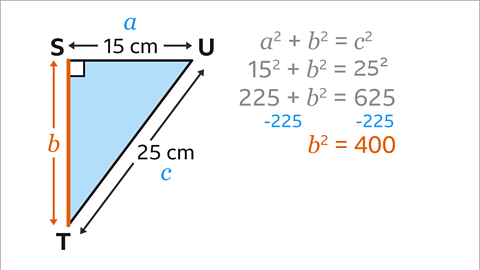
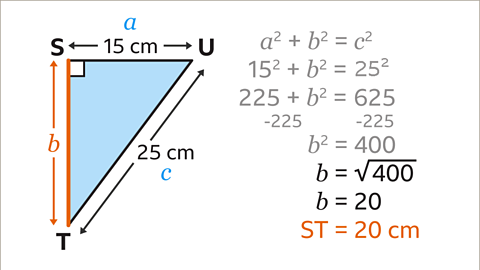
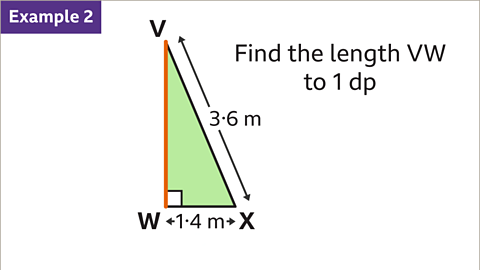
Image caption, Find the length ST
1 of 10
Question
Find the length EF.
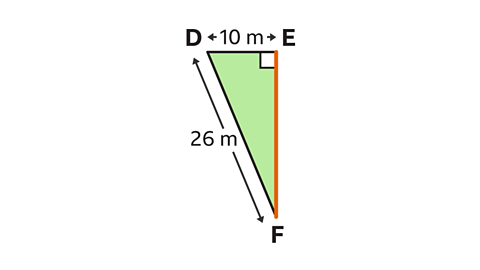
EF is the length from E to F.
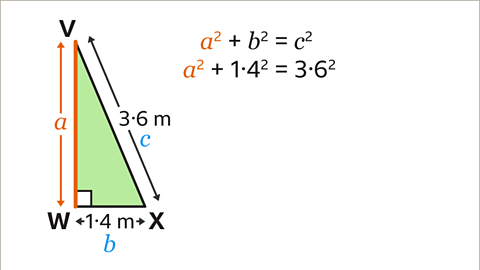
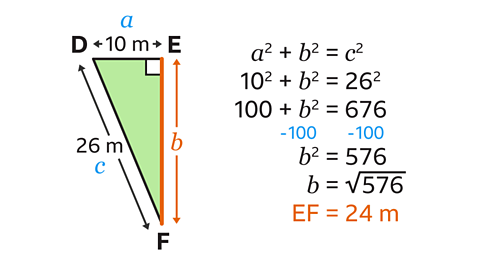
26 m is the hypotenuse, so should be labelled as \(c\). 10 m can be labelled as \(a\) and EF can be labelled as \(b\).
Substitute these values into \(a\)² + \(b\)² = \(c\)² to give 10² + \(b\)² = 262
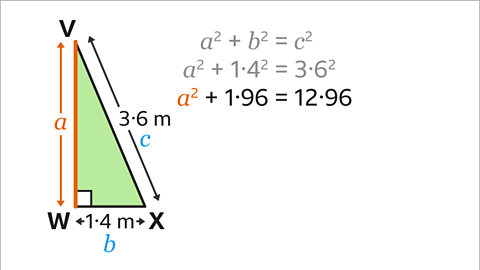
10² is 100. 26² is 676. This leads to the equation 100 + \(b\)² = 676
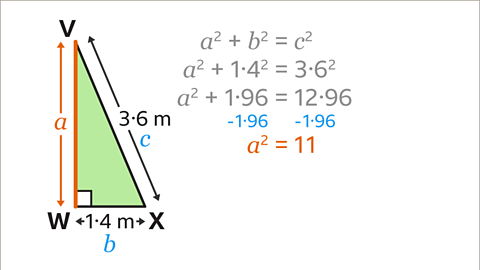
Subtract 100 from both sides to give \(b\)² = 576
To find \(b\), the inverse of squaring is square rooting, so \(b\)=√576=24
Therefore, EF = 24 m.
Practise using Pythagoras' theorem
Quiz
Practise calculating different lengths of sides using Pythagoras' theorem with this quiz. You may need a pen and paper to help you with your answers.
Real-life maths
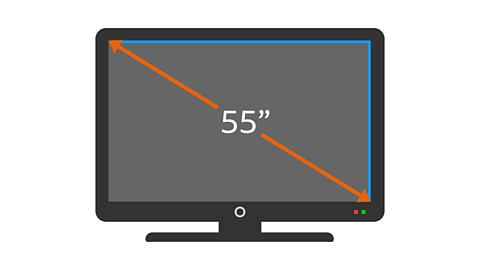
Flat screen televisions are usually measured diagonally from opposite corners of the screen.
This means that a 55 inch television does not have a width of 55 inches.It would measure 55 inches from the top left corner to the bottom right corner (as opposite.)
Pythagoras’ theorem can be used to calculate the diagonal size of the television screen, if the width and the height are known.
Revise for your exams with BBC Bitesize
Get ready for the GCSEs with quizzes, past papers, flashcards, podcasts and more resources!

More on Pythagoras and trigonometry
Find out more by working through a topic
- count2 of 5
- count5 of 5