What is International Literacy Day?
International Literacy Day takes place on 8 September every year.
It is a day to remind people around the world how important reading and writing skills are.
International Literacy Day was celebrated for the first time in 1967.
Watch – Read a book!
Reading a book can open a whole new world of adventure and excitement. Watch this video to learn more why books are so amazing!
Join Lucy and Kevin as they open their books and journey in search of Treasure Island.
LUCY: My friend Kevin loves reading.
Kevin!
KEVIN: Just a second.
LUCY: See what I mean? And one day he showed me why.
I just asked him – what are you reading?
KEVIN: Treasure Island. It's brilliant!
It's all about a boy called Jim Hawkins who finds a treasure map, a proper one with an X and everything.
He shows it to some grown-ups, and they go off on a big adventure to find gold and jewels.
But guess what?
LUCY: What?
KEVIN: It turns out that the sailors on the ship are all pirates. And the ship's cook is the sneakiest pirate of all. Long John Silver!
LUCY: What happens next?
KEVIN: I don't know. That's as far as I've got.
LUCY: It was too much. I had to know.
I went to the library and got my own copy.
TOGETHER: We couldn’t put it down!
LUCY: On Saturday, Kevin came round to my house and we dressed up as Treasure Island characters.
We made hats from cardboard and a treasure chest from a box, and used old clothes as the pirate costumes.
When we got to the playground, I was Jim Hawkins and Kevin was Long John Silver.
We made whole new stories.
KEVIN: Jim Hawkins, look here. I can see some treasure off the starboard bow.
LUCY: Looks like it's time for a whole new adventure.
TOGETHER: What are you reading?
Reading
Reading is an important skill to have.
Being able to read things around you allows you to learn about the world.
Reading books is also an enjoyable way to explore your imagination!
Have a look at the information and activities below to learn more.
Why are reading and writing important?
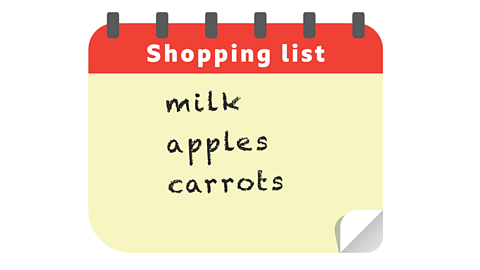
Being able to read and write helps us in our every day life. For example, it helps us to:
write shopping lists
read sign posts
read and write cards
read food labels
Can you think of any other times that reading and writing helps us?
Books
Reading books is a great way to learn new words and spark your imagination.
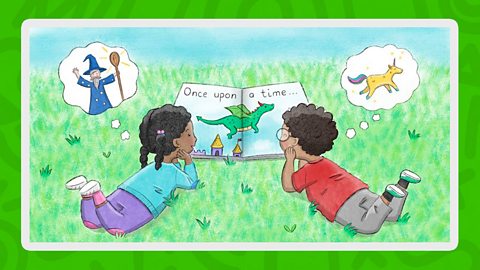
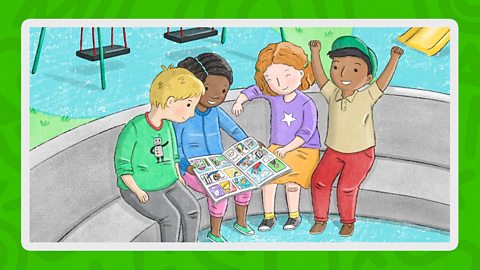
There are lots of different types of books, from information books to storybooks.
Have a look at this slideshow to learn about different kinds of books.
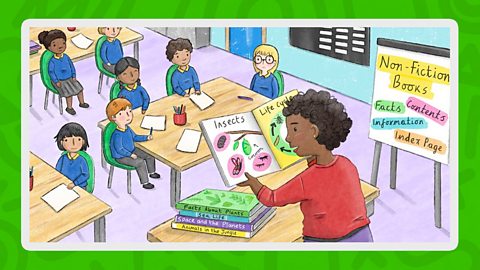
Image caption, Non-fiction books
Non-fiction books are about real things, such as facts about the world around us. There are many different types of non-fiction writing. These include information books, newspapers and magazines
1 of 4
Discover more on KS1 reading
Have a look at these articles to learn more and improve your reading skills.
What is alphabetical order?
KS1 English
Reading and understanding a text
KS1 English
Reading instructions
KS1 English

Writing
Writing is a very important skill to have.
It helps you create all kinds of things, such as stories, poems letters and descriptions
As you learn new vocabulary (the bank of words you know) your writing becomes more interesting.
Have a look at the information, videos and activities below to discover more about writing and how you can improve your skills.
Watch - Exciting writing
Watch this video and follow the brave knight on her exciting quest to find out some new vocabulary.
Josh is sat at a desk holding up a pen and paper excitedly.
Pens and paper at the ready. Let’s do some exciting writing!
As the storyteller, you help us see the story as you imagine it.
A thought bubble appears above Josh’s head, filling the screen.
We see Aria dressed in a suit of armour.
Yes, our main character. A courageous knight on an epic quest.
Our hero is looking for treasure… but where?
Aria the knight performs actions to represent brave and courageous, before looking down at a treasure map of the castle with a route marked in red.
In a dark, spooky castle of course.
Aria the knight creeps through a dark corridor as a roar echoes through the castle.
Thunderous roars echo through the room.
Gruesome ghosts hide around every corner.
We see spooky hands and eyes peeping around corners and hiding in the dark.
Wow, that was exciting.
The nightmarish roars get louder as they approach a large creaky door.
The door is slowly opening with a tense, heavy, rusty creak.
What beast must lay on the other side? A spiky, scaly, smelly and… small dragon.
We see close ups of parts of the dragon’s body, the teeth, the scales, the spikes, a plume of fart.
Ahh, they look like an adorable, friendly dragon.
Look! The treasure, how intriguing! Oh, another treasure map!
A great starting point for our next piece of exciting writing!
Discover more on KS1 vocabulary
Are you ever lost for words? Here are some articles to help build your vocabulary.
Amazing art vocabulary
KS1 English
Disastrous drama vocabulary
KS1 English
Funny friends vocabulary
KS1 English
Story writing
There are lots of different types of stories (genres) such as science fiction, fairy stories, scary stories and mysteries.
Every story always has a beginning, a middle and an end.
The plot is what will happen in a story and this can be different depending on what type of story it is.
Activity - Story starter
Why not have a go at writing your own story?
It can be hard to think of new characters, a setting and a plot all at once.
Use the story starter activity to help you get started.
Poetry writing
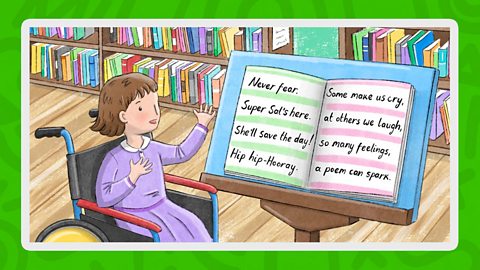
Poems can be short or long and they can be about anything you feel like writing about.
Some poems rhyme, but they don't have to. When words rhyme, they share the same ending sounds - like 'cat', 'rat' and 'mat'.
Poems can also have a rhythm. Rhythm is the beat and pattern in a poem, which can make it fun to read aloud.
Activity - Find the rhyming word
Have a go at this activity and see if you can match the correct rhyming word to the picture.
Discover more on KS2 writing
Writing recounts
KS1 English
Checking your writing makes sense
KS1 English
Learning spellings and using patterns
KS1 English
Play - Bitesize English games
Have a go at these fun KS1 English games to improve your reading and writing skills.
Karate Cats English Game
Learn and practise: spelling, grammar and punctuation with Karate Cats
Small Town Superheroes English Skills Game
Perfect your punctuation, tackle tricky spellings and grow your grammar skills with this English game.
More resources from the BBC
You can find many more amazing resources from around the BBC.
Follow the links below for more ideas on Literacy.
Blue Peter Book Club
Blue Peter
illustrated audio stories
Bitesize for Teachers
Super Movers English Collection
Bitesize for Teachers
Where next?
Play Bitesize Primary games. game
Fun and educational primary games in science, maths, English, history, geography, art and design, computing and modern languages.