Can the New World Screwworm be stopped?
What can halt the current outbreak of the New World Screwworm?
Flesh-eating parasitic flies have been found in the US state of Texas for the first time in decades. Known as the New World Screwworm, officials have now put plans in place to try and contain its spread. The fly feeds off warm-blooded animals, like cattle, dogs and horses, but if detected early enough, with treatment, the animals can make a full recovery. It can also infest humans, but human deaths are rare and it poses no food safety issues.
The New World Screwworm is not a new problem; it is considered endemic in South America and some parts of Central America, towards South America. But despite the United States declaring itself screwworm free in the 1960s, the country has since seen several outbreaks. Officials have been tracking this latest case since late 2024.
To date, the most widely used method to try and control the spread of the screwworm is the Sterile Insect Technique, whereby millions of flies are hatched and exposed to radiation, before they are released into the wild. And the idea here is that as the females only mate once in a lifetime, any eggs they lay will be unfertilised and will not hatch. There is currently only one facility hatching these flies in operation and there are not enough sterile flies being produced. In addition, there is a concern over a lack of knowledge among new veterinary recruits on how to deal with a problem that many may be experiencing for the first time.
So, on The Inquiry this week, we’re asking ‘Can the New World Screwworm be stopped?’
Contributors:
Grace VanHoy, veterinarian and professor, UC Davis Weill School of Veterinary Medicine, California, USA
Thomas Rath, author and assistant professor, History Department, University College London, UK
Dr Phillip Kaufman, professor and head of department of entomology, Texas A&M University, chair of the Texas A&M AgriLife New World Screwworm Task Force, USA
Rui Cardoso Pereira, head of insect pest control section, Joint FAO/IAEA Programme of Nuclear Techniques in Food and Agriculture, International Atomic Energy Agency, Vienna, Austria
Presenter: Charmaine Cozier
Producer: Jill Collins
Researcher: Amelia Cox
Editor: Tom Bigwood
Technical Producer: Craig Boardman
Production Management: Phoebe Lomas and Liam Morrey
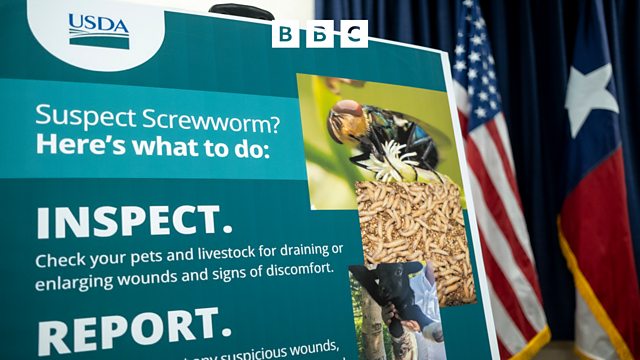
(Photo: New World Screwworm poster. Credit: Joel Angel Juarez/Getty Images)
On radio

Featured
.
Broadcasts
- Thu 2 Jul 202607:06GMTBBC World Service
- Thu 2 Jul 202614:06GMTBBC World Service
- Thu 2 Jul 202617:06GMTBBC World Service East and Southern Africa & West and Central Africa only
- Thu 2 Jul 202621:06GMTBBC World Service except East and Southern Africa & West and Central Africa
- Sat 4 Jul 202618:06GMTBBC World Service except East and Southern Africa & West and Central Africa
- Sun 5 Jul 202611:06GMTBBC World Service East and Southern Africa & West and Central Africa only
- Mon 6 Jul 202602:06GMTBBC World Service News Internet
Podcast
![]()
The Inquiry
The Inquiry explores the trends, forces and ideas shaping the world

Related Content
