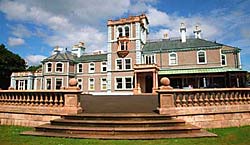
Larne - Drumalis House Drumalis - a short history of a magnificent house - page 1 | | |  | | Drumalis House, Larne - beautifully restored (2003) | |
The first written record of the name Drumalis comes from a sixteenth century calendar that lists lands adjoining and belonging to the church of the friars called Clondumalis. The name 'cluan' or 'cluain' refers in Irish to a meadow. It is a prefix which was also used for a meadow with a religious use such as the site of a church or monastery. 'Drum' refers to a round hill, with a circular mound of earth or embankment - 'Lios'. In the 1700s a family named Smiley came to Northern Ireland from Scotland. It appears that these first Smiley immigrants were of the labouring class and it must assumed that they would have originally lived in workmen's cottages.. However the family prospered steadily and it is known that by 1824 John Smiley was a watch or clock maker. | | |  | | Sir Hugh Smiley | |
Sir Hugh Houston Smiley was third generation of this family and was considerably wealthy. He bought the Drumalis site in 1870 and had completed the first house by 1873, the same year he married his Scottish wife, Elizabeth Kerr. The Kerr family owned a major cotton and sewing thread industry in Paisley - (then known as Coates, Clark, Kerr). It is said that it was Sir Hugh's money that bought the site and built the original house and it was his wife's money that funded the further stages of development of the house. ___________________________
| | | 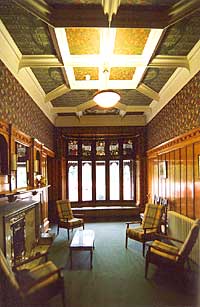 | | The Foyer at Drumalis House | |
In the foyer there are five stained glass windows which reflect the influences within the family. There are three main windows, being an Irish, a Scottish and an English window. The Irish and Scottish influences are obvious. The English window is assumed to be due, in part, to the English connections Elizabeth Kerr's father had since he sourced all of his cotton supplies from Lancashire. The two remaining windows alternate with the three main ones and show the Irish harp - for Ireland, the Lion rampant being the Scottish emblem and the Lions recumbent of England. Essentially these two windows are a pair but the order in which the emblems appear within the window are intentionally different. |
| | |  | | The English Window | |
| | | |  | | The Scottish Window | |
| | | |  | | The Irish Window | |
|
Click here to listen to Susan Skinner from the BBC bus take a tour of the house in the company of Sister Margaret Rose and Sister Anna, for the Your Place & Mine programme. (To access audio and video on your place and mine you need RealPlayer .) |
|
YOUR RESPONSES Sir John Smiley - Feb '08
From Sir John Smiley
Dear Linda Bailie
I have just 10th Feb seen your note. The John Smiley referred to remained in
Larne and married Anne Reid. They had among other children the Hugh Smiley who
married Elizabeth Kerr. They are my great-grand parents. Hugh became the 1st
Baronet and the title has passed directly through two generations to me, the
4th Baronet.
Therefore we are related. I should call you cousin Linda!
John - Mar '07
I was in this house it is amazing Linda Bailie - Mar '07
Is it known if the John Smiley referred to in this article was the same John Smiley that set sail to Quebec on the Despatch that wercked off the coast of Newfoundland? My great-great grandfather, Joseph Smiley (John's brother), was on the ship with John and his family. All were rescued and eventually settled in Nova Scotia. Am Curious to know if Sir Hugh Smiley' descendants are relatives. I will be in Ireland in April and plan on visiting the Drumalis House. This is a very interesting article about the house and I am eager to see it. | 


 print version





















 POST A COMMENT ON THIS ARTICLE