Energy bills to rise for millions as impact of Iran war hits

 Getty Images
Household energy prices will rise by 13% a year in July, as soaring wholesale costs caused by the US-Israel war with Iran hit bills for the first time.
Regulator Ofgem says the war means a household using a typical amount of gas and electricity will pay £221 more a year, with an annual bill of £1,862.
The cap affects millions of homes on variable tariffs in England, Scotland and Wales, and suppliers are warning it could go even higher in the colder winter months without an end to the conflict.
Energy costs have rocketed since Iran responded to US and Israeli attacks by effectively blocking the crucial Strait of Hormuz shipping route.
A fifth of the world's oil and gas usually flows through the waterway.
The jump in bills will equate to a rise of £18 a month for the average household using both electricity and gas, with households seeing an increase of 24% on their gas bills and 5% on their electricity bills. Standing charges are almost unchanged.
The energy cap covers 33 million households in England, Wales and Scotland. Regulation and bills are different in Northern Ireland.
The cap fixes the maximum amount customers can be charged for each unit of gas and electricity via variable tariffs. About 40% of bill-payers have fixed tariffs and are unaffected because their price will not change until the end of their fixed term.
The cap has been illustrated by Ofgem, by calculating the annual bill for a "typical household" using 11,500 kWh of gas and 2,700 kWh of electricity a year with a single bill for gas and electricity, settled by direct debit.
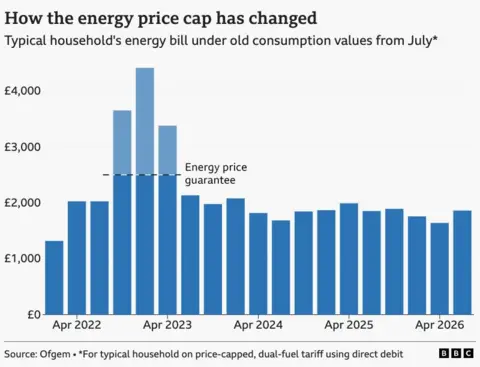
The jump in costs for households is set to kick in after domestic energy bills fell by 7% between April and July, following a shake-up in charges by the government.
That change was announced just before the Iran war began. However, the cap from July to September reflects the 25% increase in the global price of gas caused by the war, particularly the effective closure of the Strait of Hormuz.
The wholesale price, paid by suppliers, makes up about 40% of a household gas and electricity bill. Some energy suppliers have forecast that energy prices could move even higher by the autumn and winter.
Ofgem chief executive Tim Jarvis said: "We understand many will be concerned about rising prices.
"While energy use typically falls over the summer months, there are still practical steps households can take to manage costs, including exploring fixed tariffs or changing their payment method."
The government has said it is working on plans for provide targeted support for those most in need if bills were expensive into the winter, when households use more energy.
A typical household is already paying about £600 a year more than before the price shock of 2022-23, although the latest increase and total bills are lower than that crisis period, which was partly by Russia's invasion of Ukraine.
Billions of pounds is owed to suppliers in unpaid bills, and many people with disabilities have high energy use throughout the year to run specialist equipment.
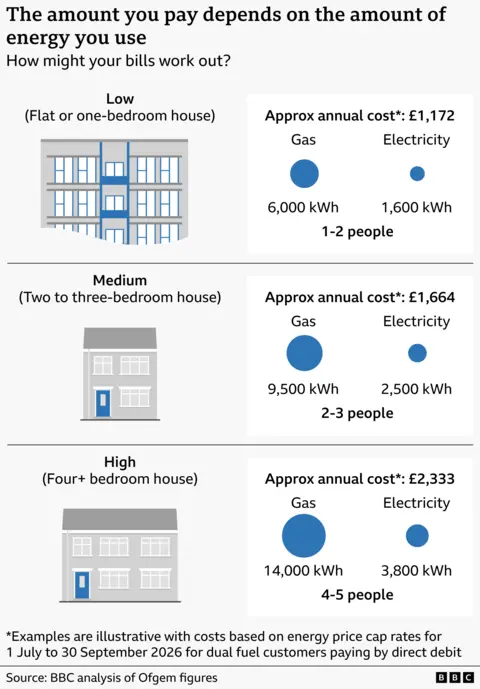
Ofgem has decided to reduce what it believes to be a "typical" level of energy use, because many households have cut back owing to high prices of recent years, and energy efficiency has improved. Its new estimate is 9,500 kWh of gas and 2,500 kWh of electricity a year.
That could mask what remains a sharp rise in prices, and will not change the fact that consumers will pay considerably more for each unit of energy.
From July:
- The "typical" bill under current usage estimates will be £1,862 (a rise of £221 a year)
- The "typical" bill under possible new usage estimates will be £1,663. However, the current cap using those estimates would be about £1,490, so the rise would be similar
Ofgem made changes to these so-called typical domestic consumption values in 2019 and 2023.
Winter threat
Experts say that millions of households have turned down radiators and thermostats, taken shorter showers, blocked draughts, and found ways to keep the heating off in certain rooms to lower bills.
Preparations made during a hot summer to revisit these habits and improve energy efficiency at home could help as prices rise again, they say.
Energy Secretary Ed Miliband said: "The rise in the price cap because of a war we did not choose is deeply unwelcome news for households across the country. We know people were under pressure before this crisis, and that's why easing that burden is our number one priority."
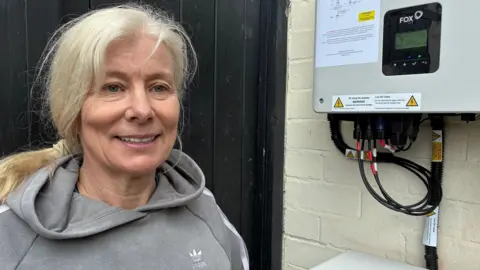
Julie Clague has been taking every step she can to keep heating costs down, such as using an electric blanket and keeping the heating off.
"I don't always heat the home, I heat the person," she said.
But the 59-year-old has now qualified for free solar panels, owing to where she lives in Derby and what she earns. She is finally feeling more upbeat about getting through next winter.
"Last winter was so cold, so I'm really, really looking forward to a cosy winter when the solar panels are going to help me generate some power so I can keep warm."
The new system was organised by community company YES Energy Solutions, which works with the city council.
Even if people are not eligible for a grant for major work, small changes of habit can help keep costs down, according to its chief executive Duncan McCombie.
It distributes a simple pack which includes a key to bleed radiators, window insulation, draught proofing, a thermometer, and even an egg timer to keep shower times short.
"People probably feel as though they've made changes but can they do more," he said.
Energy UK, which represents suppliers, said that energy bills remained unaffordable for many people.
"It's another unwelcome reminder – coming too soon after the last one – of how our country's high dependence on gas leaves us exposed to price spikes we can do nothing about resulting from conflicts thousands of miles away," said Ned Hammond, deputy director of customer policy at Energy UK.
It said that companies offered struggling customers repayment plans and arranged breaks from paying bills, as part of various support measures.


Get our flagship newsletter with all the headlines you need to start the day. Sign up here.
